


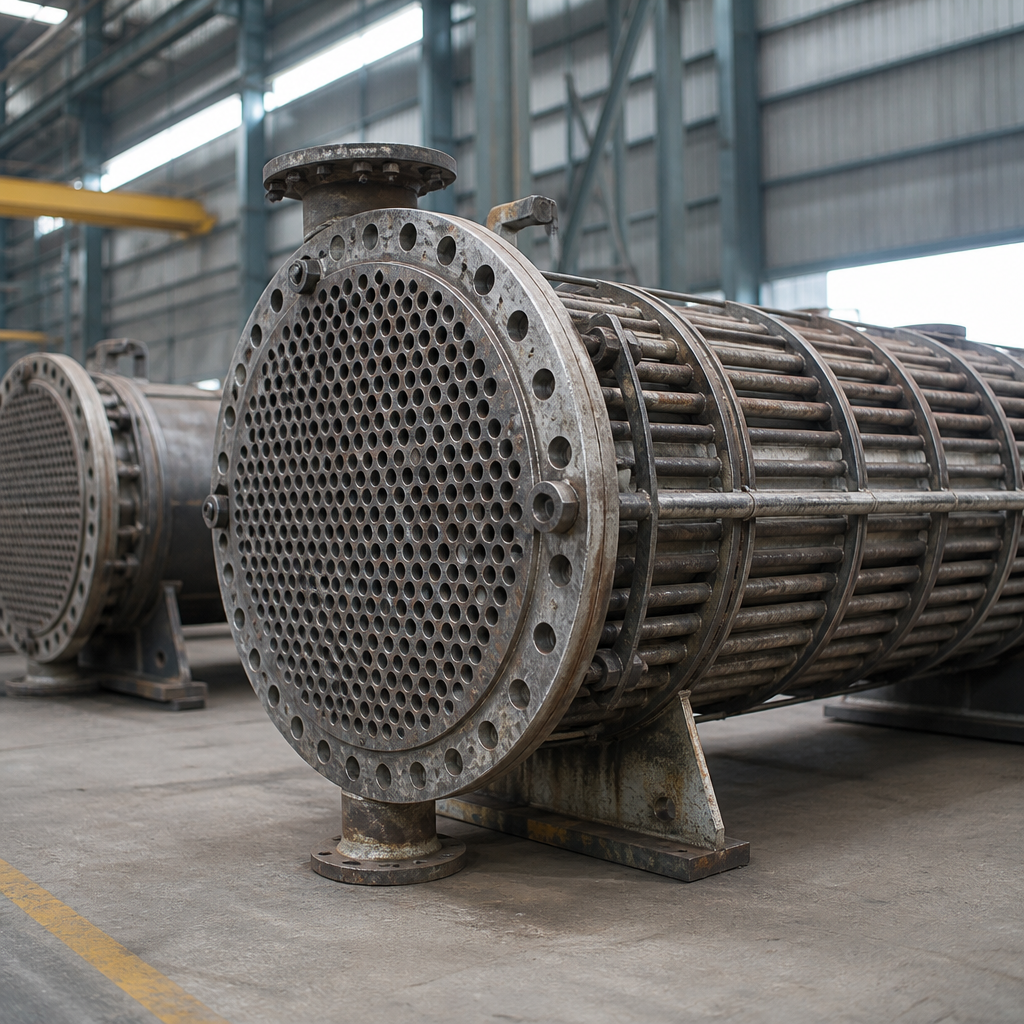
Industrial facilities are constantly under pressure to reduce capital expenditure without compromising operational efficiency. In this environment, procurement decisions carry enormous weight. Every piece of process equipment must justify its cost through reliability, performance, and longevity. For plant managers and engineers navigating tight budgets, the secondary equipment market has emerged as a genuinely viable alternative to purchasing new machinery — and heat exchangers sit at the very center of that conversation.
Understanding the Role of Heat Exchangers in Process Plants
Heat exchangers are among the most fundamental components in any process plant. They transfer thermal energy between two or more fluids without allowing them to mix, enabling precise temperature control across a wide range of industrial applications. From petrochemical refining and food processing to pharmaceutical manufacturing and power generation, heat exchangers are indispensable to maintaining process integrity and energy efficiency.
The most common types include shell-and-tube, plate-and-frame, air-cooled, and double-pipe configurations. Each design serves specific operational requirements, and selecting the right type for a given application is critical. Shell-and-tube exchangers, for instance, are preferred in high-pressure environments, while plate-and-frame units offer superior surface area efficiency in lower-pressure systems. Understanding these distinctions is essential before making any procurement decision.
The Case for Sourcing Pre-Owned Process Equipment
The industrial equipment market has matured considerably over the past two decades. What was once a fragmented, opaque sector has evolved into a structured marketplace where quality, traceability, and certification are taken seriously. Pre-owned process equipment — when sourced from reputable suppliers — can deliver performance comparable to new units at a fraction of the acquisition cost.
For heat exchangers specifically, the cost savings can be substantial. New shell-and-tube units manufactured from high-grade stainless steel or exotic alloys can run into hundreds of thousands of dollars. A well-maintained used equivalent, inspected and reconditioned by a specialist supplier, may cost 40 to 70 percent less while meeting the same operational specifications. For facilities managing multiple units across a large plant, those savings compound significantly.
Quality Assurance in the Secondary Market
One of the most common concerns about purchasing used equipment is uncertainty around condition and history. Reputable suppliers address this through rigorous inspection protocols, including hydrostatic pressure testing, non-destructive examination, and full documentation of prior service history. Buyers should always request material test reports, previous inspection records, and any available maintenance logs before committing to a purchase.
Reconditioning services — which may include tube bundle replacement, re-gasketing, cleaning, and surface treatment — can restore a used heat exchanger to near-original performance standards. When these services are performed by qualified engineers using OEM-grade materials, the resulting unit can be expected to deliver reliable service for many years.
Integrating Heat Exchangers with Broader Drying and Thermal Systems
Heat exchangers rarely operate in isolation. In most industrial settings, they form part of a larger thermal management system that may include dryers, condensers, evaporators, and heat recovery units. Understanding how these components interact is essential for optimizing overall plant efficiency. For example, in facilities that use industrial dryers, heat exchangers often play a critical role in pre-heating incoming air or recovering waste heat from exhaust streams.
Investing in modern drying technology alongside efficient heat transfer equipment can yield compounding energy savings. Upgrading to advanced industrial dryers not only reduces energy consumption but also improves product quality and throughput — benefits that are amplified when paired with a well-matched heat exchanger operating at peak efficiency. Facilities that take a systems-level approach to thermal management consistently outperform those that treat each component as an isolated procurement decision.
Energy Recovery and Sustainability Goals
Sustainability has become a core operational priority for industrial facilities worldwide. Heat exchangers are central to energy recovery strategies, capturing thermal energy that would otherwise be lost to the environment and redirecting it to productive use. This not only reduces fuel consumption and associated costs but also lowers a facility’s carbon footprint — an increasingly important metric for regulatory compliance and corporate reporting.
Facilities that invest in high-efficiency heat exchangers, whether new or pre-owned, often find that the energy savings alone justify the capital expenditure within a relatively short payback period. When combined with other efficiency measures, the cumulative impact on operating costs and environmental performance can be transformative.
Supporting Equipment: Pumps and Fluid Handling Systems
No heat exchanger operates effectively without a reliable fluid handling system to circulate the process and utility fluids. Pumps are the workhorses of this infrastructure, and their selection, sizing, and maintenance are just as important as the heat exchanger itself. Hydraulic pumps, centrifugal pumps, and positive displacement units each have distinct characteristics suited to different flow and pressure requirements. For engineers seeking a deeper understanding of pump selection and application, this detailed guide to hydraulic pumps provides a thorough technical overview of the key considerations involved in specifying the right unit for a given system.
Ensuring compatibility between pump performance curves and heat exchanger pressure drop characteristics is a fundamental step in system design. Mismatched components can lead to inefficient operation, premature wear, and costly downtime — outcomes that undermine the financial case for any equipment investment, new or used.
International Process Plants: A Trusted Source for Pre-Owned Heat Exchangers
When sourcing pre-owned process equipment, the reputation and expertise of the supplier matter enormously. International Process Plants has established itself as a leading global supplier of quality used process equipment, with an extensive inventory spanning a wide range of industries and applications. Facilities looking to acquire a used heat exchanger from a trusted source will find a comprehensive selection of inspected, documented units available for immediate purchase or customized reconditioning. Their team of experienced engineers provides technical support throughout the procurement process, ensuring that buyers select equipment precisely matched to their operational requirements.
International Process Plants maintains rigorous standards for equipment inspection and documentation, giving buyers the confidence they need to make informed decisions. Their global reach and deep industry relationships mean that even highly specialized or hard-to-find units can often be sourced efficiently, reducing project lead times and keeping capital projects on schedule.
Making the Right Procurement Decision
Choosing between new and pre-owned heat exchangers ultimately comes down to a careful analysis of operational requirements, budget constraints, timeline pressures, and risk tolerance. For many facilities, the secondary market offers a compelling combination of cost efficiency, availability, and performance — particularly when working with a supplier that prioritizes quality and transparency.
Engineers and procurement professionals should approach used equipment purchases with the same rigor they would apply to any capital investment: thorough due diligence, clear specification requirements, and a realistic assessment of total cost of ownership over the expected service life of the unit.
Conclusion
Heat exchangers are critical assets in any process plant, and the decision to source them from the secondary market is one that deserves careful, informed consideration. When approached strategically — with attention to equipment condition, supplier credibility, system compatibility, and long-term performance expectations — a pre-owned heat exchanger can deliver exceptional value. In an era where operational efficiency and cost discipline are non-negotiable, the secondary equipment market deserves a prominent place in every procurement strategy.
