


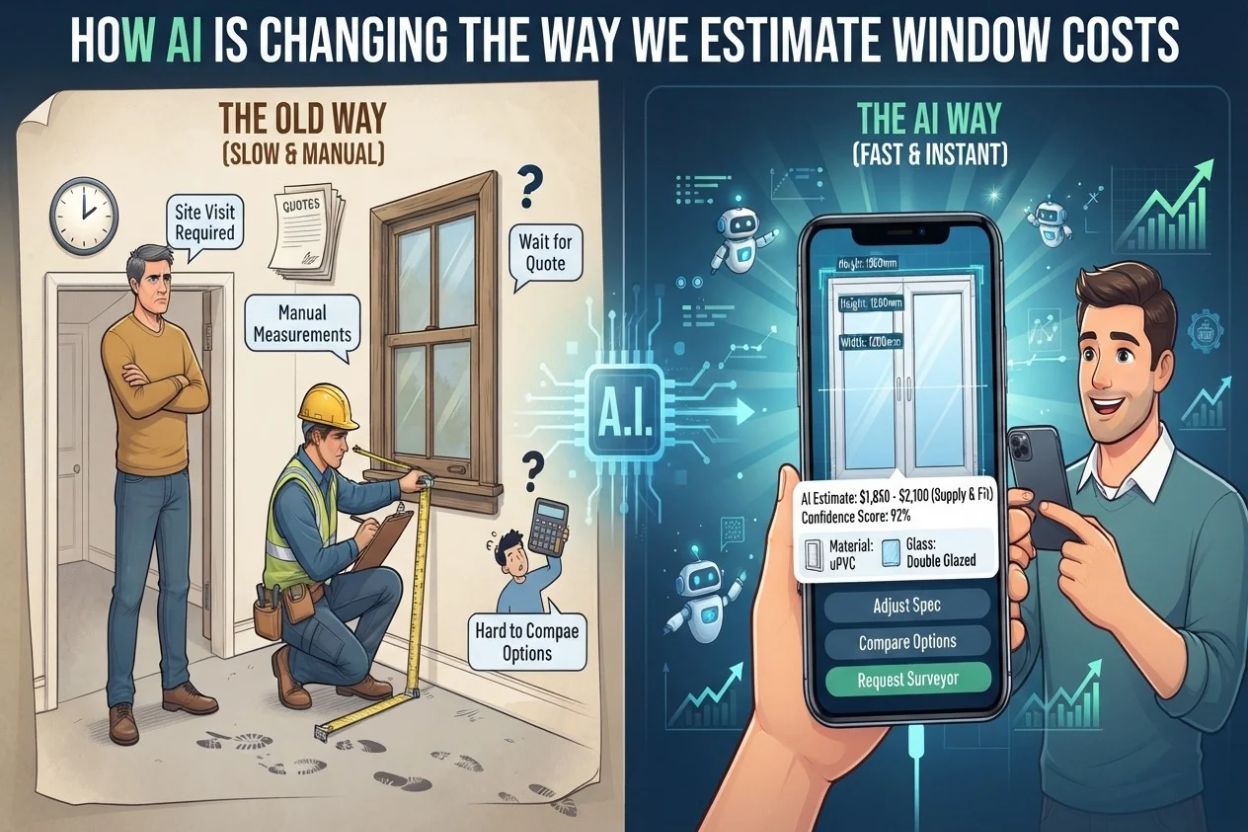
Not so long ago, finding out what new windows would cost meant a fairly slow routine. You rang a few companies, waited for someone to visit, stood in the hallway while they measured every frame, and then waited again for a written quote to arrive. If you wanted to compare options, you repeated the whole process.
That picture is changing fast. Artificial intelligence is now being built into tools that can look at a photo of your window, work out its size and suggest a price within minutes. For homeowners, installers and landlords alike, it is reshaping the early stages of a window project. Here is how it works, what it does well and where a healthy dose of caution still makes sense.
The Old Way: Slow, Manual and Inconsistent
Traditionally, window pricing relied on a lot of human effort. A surveyor or salesperson would visit, measure each opening by hand, note the style and condition, and then go back to the office to work out a price. It was thorough, but it had drawbacks.
- It took time. Booking visits and waiting for quotes could stretch over weeks.
- It was inconsistent. Different firms priced the same job differently, with different inclusions.
- It was prone to human error. A misread measurement or a missed detail could skew the quote.
- It was hard to compare options. Changing a specification meant asking for a fresh quote.
For early-stage planning, when you are simply trying to decide whether a project is affordable, that is a heavy process for a basic question.
What AI Brings to the Table
AI does not replace the whole process, but it speeds up the front end dramatically. Modern tools combine several techniques.
Image recognition
The software can analyse a photo or even an architectural drawing and identify the window opening, its proportions and its scale. Instead of reaching for a tape measure, you take a picture and the tool does the first pass.
Automated measurement
Once the window is recognised, the AI produces an estimated width and height. Many tools also attach a confidence score to each window, showing how reliable the estimate is. That is a useful idea, because it admits that some photos are clearer than others.
Instant pricing
With dimensions in hand, the tool applies pricing data and your chosen specification to produce an estimate. Change the material, glazing or style, and the figure updates immediately.
Consistency
Because the logic is the same every time, a calculator treats every enquiry in the same way. It does not have a bad day, and it does not guess differently depending on who is asking.
How a Photo-Based Window Cost Calculator Works
The process is simpler than it sounds. A typical AI-powered window cost calculator follows these steps:
- You upload a photo, a drawing or a sketch, or simply enter the dimensions by hand.
- The AI analyses the image, identifies the window and estimates its measurements.
- You choose your options, such as style, material, glazing and finish.
- The tool generates an estimate, often for supply only or supply and installation.
- You review the result, adjust the specification if you wish and compare prices.
- A human check follows, with a survey or manual verification before anything is ordered.
That final step matters. The best tools treat the AI estimate as the beginning of the process, not the end.
Who Benefits?
Homeowners
For homeowners, the biggest gain is speed and confidence. You can find out roughly what a project might cost on a Sunday evening, without inviting anyone into your home. You can test different materials and glazing options, and walk into conversations with installers already knowing the ballpark.
Installers and contractors
For tradespeople, faster early-stage pricing means less time spent on enquiries that will never convert and more time on jobs that will. A quick, consistent estimate can also make a good first impression.
Landlords and developers
Anyone budgeting across several properties can benefit from a quick way to price multiple windows without arranging a separate visit to each one.
Architects and designers
At the feasibility stage, rough costs for window packages help shape design decisions before detailed specifications are drawn up.
Where AI Still Has Limits
For all its convenience, AI is not magic. It is worth understanding where the technology can stumble.
Photo quality. Blurry images, odd angles, glare and shadows can all affect accuracy. Clear, straight-on pictures give the best results.
Hidden problems. AI cannot see rotten sills, damaged lintels or crumbling plaster behind the frame. These issues can change the real cost.
Unusual windows. Curved, arched or heavily detailed windows are harder to measure and price from an image.
Planning and heritage rules. A tool cannot tell whether your listed building needs specific materials or consent.
Estimates, not quotes. The output is indicative. Final pricing is confirmed after validation and survey checks.
This is why reputable platforms are open about confidence levels and always recommend a manual check before manufacture.
What Good AI Tools Get Right
If you are choosing an online estimator, a few signs suggest a well-designed one.
- It shows confidence scores or similar indicators rather than pretending to be perfectly precise.
- It lets you adjust the specification and watch the price update.
- It explains what is included, such as supply only versus supply and fit.
- It is clear about the next steps, including surveys and verification.
- It has a transparent privacy policy explaining how your photos and data are used.
Using AI Estimates Sensibly
To get the most from these tools, follow a few simple habits.
- Take good photos. Stand square to the window, capture the whole frame and use good daylight.
- Cross-check if you can. A quick tape measurement on one or two windows is a useful sanity check.
- Treat the result as a range. Add a contingency of 10 to 15 per cent for the unexpected.
- Get formal quotes. Use your estimate as a benchmark when quotes arrive.
- Book a survey. A professional check remains essential before an order is placed.
What Does the Future Look Like?
The direction of travel is clear. As tools improve, we can expect more accurate measurements from ordinary smartphone photos, better handling of unusual window types and smoother links between estimating, ordering, manufacturing and installation. Some platforms already aim to keep everything in one streamlined workflow, from the first photo to the final fitting.
Human expertise will still play a vital role. Surveyors, joiners and installers bring judgement that no algorithm can replicate, especially in older or more complicated properties. The likeliest future is a partnership, with AI handling the quick, repeatable early stages and people handling the detail.
Final Thoughts
AI has taken one of the slowest, most frustrating parts of buying windows and made it fast and accessible. A good window cost calculator can now turn a single photo into a meaningful estimate in minutes, helping homeowners plan, compare and prepare before they ever speak to a salesperson.
The key is to use it for what it is: a smart, convenient starting point. Combine the speed of AI with proper surveys, formal quotes and a sensible contingency, and you get the best of both worlds. Used that way, a window cost calculator is not about replacing expertise. It is about helping you arrive at that expertise better informed.
