

A product video can make a sustainability claim feel broader than the words on screen.
Place recycled packaging against a pristine landscape, add natural textures and soft lighting, and viewers may leave with the impression that the entire product is environmentally responsible—even when the evidence supports something much narrower.
That is the challenge for teams producing sustainability-focused product videos.
The goal is not simply to make an environmental improvement look appealing. It is to ensure the complete visual story does not imply more than the evidence can support.
AI video can help test that story before production. The environmental claim itself still needs to come from verified information.
Start With the Claim, Not the Moodboard
Imagine a skincare brand introducing redesigned packaging.
The company has documentation showing that the outer carton contains 80% recycled fibre. It has also measured a reduction in packaging material compared with the previous version.
Those are specific claims.
A vague creative brief might say:
Show our new sustainable packaging in a clean natural environment.
That wording already pushes the story beyond the evidence.
A better brief stays close to what has been verified:
Introduce the redesigned carton, show the reduced packaging format, and leave space for the approved statement that the outer carton contains 80% recycled fibre.
Now the creative team knows both what it can communicate and where the claim stops.
Give Every Claim a Scope
Before creating the video, separate evidence from creative treatment.
| Element | Source |
| Recycled-content percentage | Verified supplier or product documentation |
| Packaging reduction | Approved internal comparison |
| Certification | Current certification record |
| Disposal instructions | Verified packaging guidance |
| Exact product appearance | Approved product imagery |
| Background, pacing and transitions | Creative treatment |
This creates useful freedom.
Lighting can change. The environment can be tested. Camera movement and pacing can be adjusted.
The recycled-content percentage cannot.
Scope matters too. If the evidence applies only to the outer carton, the video should not imply that the bottle, closure, label and entire product share the same environmental attribute.
Use AI to Test the Presentation
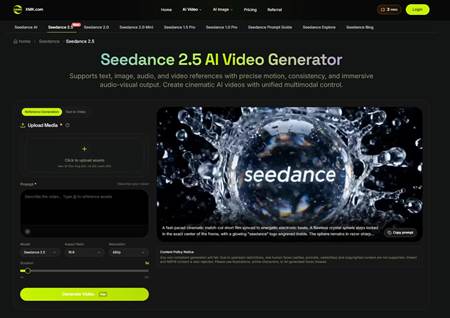
Once the claim and approved assets are clear, Seedance 2.5 can be considered for previsualization.
XMK currently presents Seedance 2.5 as a multimodal workflow using text, image, video and audio references, with generation of up to 30 seconds and local editing controls.
For a product concept, the team might work from approved product photography, packaging imagery, original graphics, a permitted environment reference and an audio mood cue.
The purpose is not to ask the model whether the product is sustainable.
It is to test the presentation:
- Does the packaging change appear clearly enough?
- Is qualifying text visible for long enough?
- Does the background distract from the evidence?
- Does the complete sequence imply a broader benefit than the approved claim supports?
Those questions are useful to answer before final production.
Pictures Can Overstate a Claim Too
Greenwashing is not only a copy problem.
Suppose a cleaning product uses a documented percentage of recycled plastic in its bottle.
A concept video places it in an untouched forest, surrounds it with growing leaves and finishes with a broad “better for the planet” message.
The recycled-content figure may be accurate. The overall impression may still go much further.
A more defensible visual story stays close to the evidence: show the relevant packaging component, state the verified improvement and include any qualification needed to understand its scope.
Broad terms such as “sustainable,” “green,” “eco-friendly” or “planet-friendly” deserve particular care when the evidence supports only a specific material or packaging improvement.
Often the narrower claim is the more informative one.
Keep Exact Evidence Out of the Generative Layer
References can guide a generation, but they do not guarantee exact reproduction.
A package can change shape. Text may be rewritten. A certification mark can distort. A material texture can look different from the real product.
Those changes matter when the visual itself carries part of an environmental claim.
If a package cutout, label, certification, percentage or disposal instruction must remain exact, keep the approved original unchanged and composite it into the final scene during editing.
Generation is better used for elements allowed to vary: background, atmosphere, transitions, framing and other supporting visuals.
The result should be treated as a creative draft rather than evidence of the product’s environmental performance.
Comparative Claims Need a Baseline
Statements such as “less plastic,” “reduced packaging” or “lower impact” immediately raise a question:
Compared with what?
If a package uses less material than its previous version, the comparison should be defined clearly where needed.
A packaging improvement should not automatically become a claim about the whole product lifecycle.
Less packaging does not by itself prove lower overall emissions. A recyclable component does not mean it will be recycled everywhere. A refill option does not mean every customer will use it.
The video should preserve those distinctions rather than smoothing them into one broad sustainability message.
Use the Draft to Compare Explanations
A sustainable product video workflow can test several ways of presenting the same verified claim.
One draft might introduce the recycled-content figure immediately. Another might first compare the old and new packaging. A third might demonstrate the refill format before explaining the packaging reduction.
The point is to compare explanations, not invent different environmental claims.
XMK also describes a local re-draw feature for targeting individual visual elements. In this context, that may help refine a non-factual background or illustrative element, but the complete clip should be reviewed again because nearby composition, lighting, motion or product details may also change.
Claims, certifications, percentages and labels should remain anchored to verified originals.
Keep a Claim Record With the Project
A simple claim record can prevent approved wording from drifting during creative review.
| Claim | Evidence | Scope | Status |
| 80% recycled fibre | Supplier documentation | Outer carton only | Approved |
| Packaging reduced by 18% | Packaging comparison | Versus previous pack | Approved |
| Refill available | Current programme | Selected markets | Qualifier required |
These figures are illustrative placeholders, not claims about a real product.
For an actual campaign, each entry should come from current evidence.
If a draft needs placeholder information before final figures are available, label it clearly and keep it internal. Every placeholder should be replaced with verified information before publication.
A polished placeholder is still a placeholder.
Protect Unreleased Product Material
Sustainability teams may work with unreleased packaging, supplier documents, internal lifecycle information or future product designs.
Access to that material does not automatically mean it can be uploaded to an external AI service.
Teams should confirm permission for external processing as well as the selected platform’s current rules. When approval is unclear, an internal concept can recreate only the necessary structure with generic components and clearly labelled placeholder information.
XMK’s current workflow rules should be checked before uploading real human faces, celebrity material, copyrighted assets or third-party materials. Teams should also confirm that they have the necessary rights and permission for external AI processing before uploading any reference.
Product-focused framing, packaging, materials, diagrams and other permitted assets are enough for this type of previsualization.
A Practical Claim-Safe Workflow
The process can stay small:
- Verify — Identify the environmental claim and the evidence behind it.
- Scope — Define exactly which product, component, market or comparison it covers.
- Previsualize — Test pacing, framing and explanatory structure without changing the evidence.
- Assemble — Add exact product imagery, claims, labels and certifications from approved originals.
- Review — Check factual accuracy and the overall environmental impression before publication.
The AI-generated draft sits in the middle.
The evidence comes first.
Specific Claims Make Stronger Stories
Sustainability communication does not need sweeping language to be persuasive.
A verified percentage of recycled material is specific. A measured reduction against the previous package is specific. A refill available in named markets is specific.
Those statements may sound less dramatic than calling a product “green,” but they tell viewers what actually changed and give the creative team something concrete to show.
AI video can help find a clearer way to present that evidence before production.
It should not make the environmental story bigger than the evidence behind it.
Plan the visual story creatively. Keep the sustainability claim specific, qualified and verifiable.
