


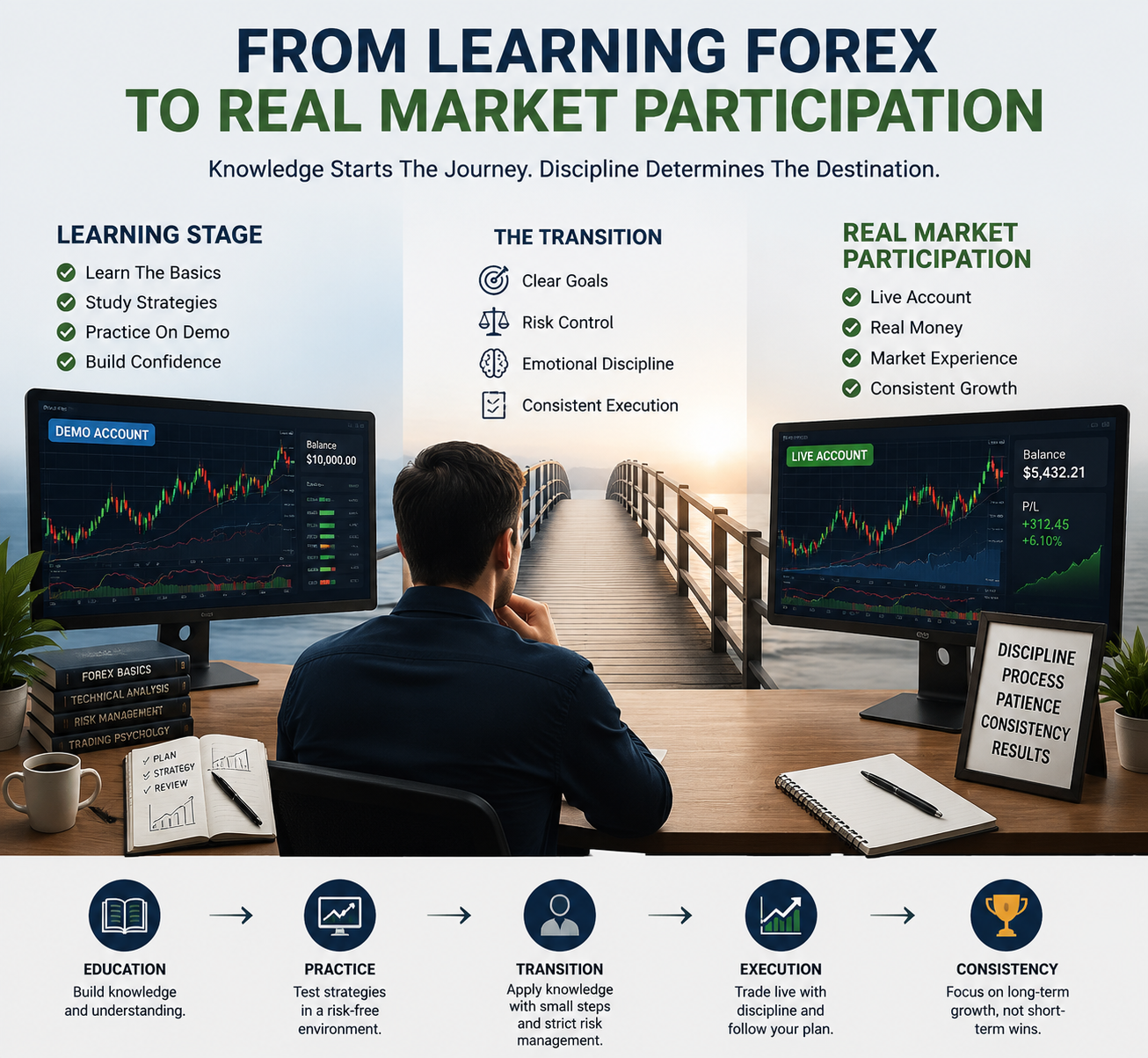
Forex attracts many learners because price charts look simple at first glance. Currency pairs move up and down. It feels like prediction is enough. In reality, the market runs on structure, timing, and risk control.
Most beginners stay in learning mode for a long time. They read theory. They test strategies on demo accounts. They understand indicators. Yet they do not move into real participation.
The shift from learning to trading is not about more information. It is about execution under pressure. Real money changes behavior instantly. It exposes weak habits that stay hidden in practice environments.
This article explains how that shift happens. It focuses on practical changes in behavior, not theory.
The Point Where Learning Turns Into Market Action
At some point, theory stops adding value on its own. Charts become familiar. Indicators make sense. But real trades still feel unstable.
The missing element is execution in a live environment. This is where structure becomes essential. A trader needs a bridge between learning and real markets. That bridge is a forex broker, the platform that connects traders to live liquidity and pricing.
A reliable forex broker does more than execute orders. It gives access to currency pairs, tools, and real market conditions. It also defines how trades are processed. Without this layer, learning stays theoretical. With it, every decision becomes real.
The transition usually starts with small live positions. Traders reduce size and move slowly. Each trade carries weight. Even small price changes feel different compared to demo accounts.
At this stage, execution matters more than strategy complexity. A simple setup executed well often beats a complex system executed poorly.
This is also where emotions become visible. Fear causes hesitation. Overconfidence leads to oversized trades. The market reacts instantly to both.
Over time, traders shift focus from prediction to consistency. The goal becomes repeatable behavior, not isolated wins.
From Demo Practice To Live Market Reality
Demo trading feels controlled. Everything executes instantly. There is no financial consequence. This creates a false sense of stability.
Live trading removes that cushion. Every action carries risk. The same strategy behaves differently when real capital is involved.
The difference is not technical. It is psychological and operational. The trader must manage pressure, speed, and consequence at the same time.
| Area | Learning Mode (Demo) | Live Market Participation |
| Capital | Virtual funds | Real money at risk |
| Emotions | Low pressure | High emotional load |
| Execution | No cost of mistakes | Mistakes have financial impact |
| Decision speed | Relaxed timing | Immediate reaction required |
| Focus | Strategy testing | Consistency and discipline |
| Feedback | Delayed learning | Instant market response |
| Risk | Theoretical | Real and irreversible per trade |
The table shows one clear fact. The market does not change. The trader does.
In demo mode, mistakes feel harmless. In live trading, they feel real. This difference shapes behavior faster than any lesson.
Many traders fail here because they do not adjust mindset. They treat live trading like practice. The market does not reward that approach.
Progress requires simplification. Fewer trades. Smaller size. Clear structure. Controlled execution.
The goal is not short term profit. The goal is survival long enough to build skill under real pressure.
Building Real Trading Discipline
Discipline is where trading either stabilizes or breaks. Knowledge alone is not enough. Even strong strategies fail without consistent behavior.
In live markets, discipline is not theory. It is repetition under pressure. It appears in every trade decision.
Key Components Of Trading Discipline
- Risk Control Per Trade
Each trade has a fixed risk level. It does not change based on emotion or recent results. - Position Size Stability
Trade size remains consistent. It only scales with long term account growth. - Clear Entry Rules
Trades are opened only when predefined conditions appear. No guessing. - Pre Planned Exits
Stop loss and take profit levels are set before entry. Decisions are not made in stress. - Controlled Trade Frequency
Fewer trades with higher quality reduce noise and overtrading. - Emotional Neutrality
Wins and losses are treated the same in analysis. No emotional reaction after outcomes. - Consistent Review Process
Trades are reviewed regularly to detect behavior patterns, not just results.
Discipline does not appear instantly. It builds through repetition. Each rule reduces randomness. Each rule increases control.
Without discipline, trading becomes reactive. With it, trading becomes structured execution.
Conclusion
The shift from learning Forex to real market participation is gradual but decisive.
Learning builds understanding. Execution builds experience. Only live trading reveals how a trader behaves under pressure.
Three core transitions define this process:
- from simulation to real capital
- from theory to execution
- from flexibility to structured discipline
Most failures do not come from lack of knowledge. They come from unchanged behavior in a changed environment.
The market stays the same. The trader must change. That change determines the outcome.
