


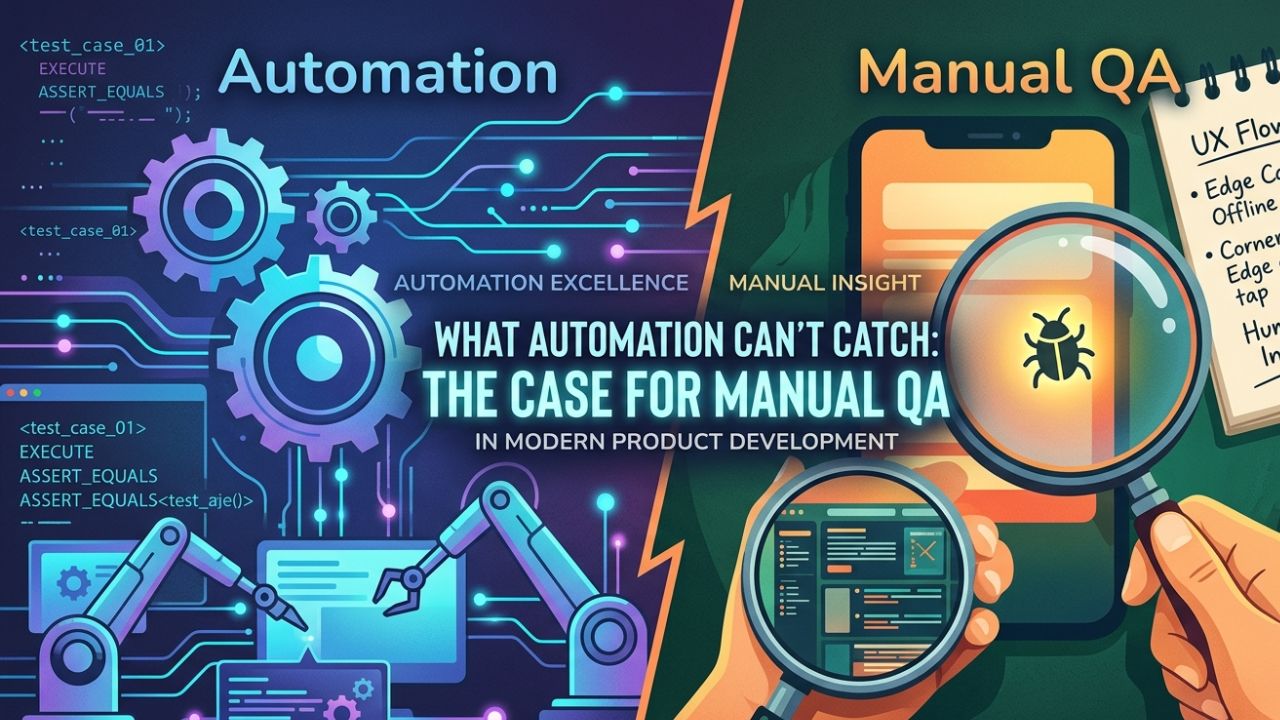
At the time of its conception, the automation-first QA strategy was reasonable. The idea was to write code for repetitive tasks, freeing up human testers to do more valuable work and expanding coverage without increasing headcount. In reality, however, most teams automated the repeatable tasks and then stopped, leaving the more valuable work uncovered and declaring the outcome to be a testing strategy.
This manifests itself in predictable ways. For example, a release that passes all automated tests may be released with a UX flow that confuses users at first. A new feature is deployed before the automation suite has stabilised, and there is no manual coverage for the interim period. An edge case that will only occur due to a particular combination of user actions is produced, since no script anticipated it.
The issue is not with automation. It is sufficient to treat it. Manual QA is not a legacy practice – it is a component of a testing strategy that deals with everything that automation cannot.
What Automation Misses and Why It Matters for Product Quality
Automated testing is accurate in what it measures and unaware of everything else. Scripts confirm the behaviour they were designed to confirm – they only fail in the context of what was expected when they were written. Anything outside that range is irrelevant.
The Anticipated Behavior Problem
A payment flow with correct processing of transactions, but with layout problems that obscure the success state, passes all functional tests written against it. An onboarding process with many steps that functions properly on each screen but results in a disorienting experience when viewed as a sequence, with sudden transitions, lack of progress indicators, and uneven copy tone, fails automation altogether. These are actual product quality failures on which retention decisions are made by the users. They never appear in automated tests since they were not in scope.
What Human Judgment Catches
The most obvious type is usability failures. A tester who has been through a feature will determine if it works in a manner that is understandable to a person outside of the context that the development team is operating in, whether the error message is informative, whether the visual hierarchy directs attention, or is confusing.
Exploratory testing reveals failure patterns resulting from combinations of actions and states that are not covered by any test plan. For example, in a SaaS product, if a user creates a record and immediately edits it before the first save is finished, and then navigates away, each action is correct, but the order causes a race condition that silently corrupts the record. No automation package tests this sequence as it was not anticipated. A skilled tester digging into the data management workflow would discover this issue by posing the question of what could go wrong rather than asking whether this particular behaviour occurs.
The temporal gap that is filled by necessity by manual QA is due to new feature releases. Automation of a new feature requires time to stabilize – it can be a sprint or more. A release that does not include any manual QA has no coverage on the functionality that the users will interact with the most after the release.
For teams that have automated the predictable and need skilled human judgment for the rest, a testing services provider with experienced manual QA specialists covers that gap without an internal hiring cycle.
How to Structure Manual QA so It Complements Automation
The most valuable teams for manual QA implement it in areas where automation cannot reach, with a clear scope and not as a backup for whatever the scripts missed.
First, the scope must be defined. Well-defined, stable functionality with predictable inputs should be included in the automated suite. Prior to automation, features stabilise, and multi-feature user journeys and UX-sensitive flows are developed. The experience of the product is as important as the correctness of the functionality in all of these areas, which fall under the scope of manual QA. This division should be reconsidered as the product develops.
Exploratory testing produces consistent results when time-boxed with a specific charter, such as a particular area or question with a documented output. For example, a charter to explore the account management flow of a user moving to a paid plan, paying particular attention to payment failure and plan downgrade edge cases, will yield focused results and enable true discovery. The 15-minute activity of recording session output (charter, tester, duration, findings, and severity) leaves a helpful record for the future.
A manual check of revenue-critical flows prior to release provides an additional layer of assurance that automated pass rates cannot offer. Known scenarios that have been passed are confirmed by automation. An experienced tester going through the checkout process can inform you whether the release is correct, whether the interactions make sense, and whether anything has moved in a way that would not have been picked up by scripts, but would have been noticed by users.
The results of manual QA should be added to the automation backlog. Repeatable, predictable failures can be automated to permanently seal coverage holes. Over time, this feedback loop causes the manual QA effort to move towards exploratory work, in which it has the greatest added value.
For teams evaluating external manual QA support, a ranked list of manual QA services gives a useful benchmark for what experienced, structured manual testing looks like across disciplines and engagement models.
Conclusion
The roles of automation and manual QA are different. Automation handles predictable and repeatable tasks. Manual QA covers everything else, such as UX failures that pass every functional check, exploratory findings that no script anticipated, and judgment calls before release that a pass rate cannot provide.
Teams that treat manual QA as a legacy practice often discover its value the hard way, for example, when a release passes all automated checks but ships with an issue that users immediately notice. However, teams that structure manual QA deliberately find that it makes their automation investment more useful, not redundant.
