
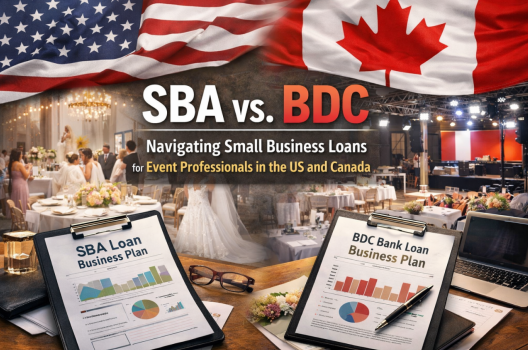
Running an event business, whether it is wedding planning, corporate events, audiovisual services, or event décor, often requires upfront capital for equipment, staffing, marketing, and venue deposits. For many event professionals in the United States and Canada, government-backed financing programs provide a reliable way to access growth capital with more flexible terms than traditional commercial loans. This is where understanding the difference between the US Small Business Administration loan programs and Canada’s Business Development Bank options becomes essential. Choosing the right path can affect approval chances, interest rates, and long-term sustainability, which is why many entrepreneurs also rely on a strong SBA loan business plan or BDC bank loan business plan to clearly demonstrate viability and repayment ability.
Understanding SBA loans for event professionals in the US
The Small Business Administration does not lend directly, but it guarantees a portion of loans issued by approved banks and lenders. The most common programs for event businesses are the SBA 7(a) loan and the SBA 504 loan. The 7(a) loan is flexible and can be used for working capital, equipment purchases, marketing expansion, and even business acquisition. This makes it suitable for event planners who need cash flow to scale operations during peak seasons.
SBA loans generally offer longer repayment terms and lower down payments compared to conventional bank loans. However, approval depends heavily on credit history, cash flow projections, and documentation. Lenders expect to see a detailed SBA loan business plan that explains revenue streams such as contracts, retainer-based clients, and seasonal demand cycles. Event professionals who can show consistent bookings and strong client pipelines often have stronger approval prospects.
Understanding BDC loans for event professionals in Canada
In Canada, the Business Development Bank of Canada focuses specifically on supporting small and medium-sized enterprises, including service-based businesses like event management companies. BDC financing often targets growth initiatives such as technology upgrades, marketing investments, or expansion into new markets. Unlike traditional banks, BDC tends to take a more development-oriented approach, meaning it may be willing to work with younger businesses that show strong growth potential.
BDC loans usually complement, rather than replace, traditional bank financing. This means event professionals may combine BDC funding with other credit sources to meet full capital needs. A strong BDC bank loan business plan is essential because it must clearly outline operational scalability, cost control, and how seasonal revenue fluctuations will be managed. Demonstrating stable contracts, long-term vendor relationships, and repeat corporate clients can significantly strengthen an application.
Key differences in eligibility and funding structure
One of the major differences between SBA and BDC programs is how risk is shared. SBA guarantees part of the loan to reduce risk for private lenders, while BDC often lends directly or co-finances with banks. In practical terms, SBA loans may involve more paperwork and longer approval timelines, but they often provide more flexible terms. BDC loans may move faster, but typically focus on clearly defined growth projects rather than general operating expenses.
Another difference is geographic and market focus. SBA programs are structured around US federal regulations, while BDC financing aligns with Canadian economic development priorities. Event professionals who operate across borders or plan to expand internationally should carefully align financing with their primary market and business registration.
Choosing the right path for your event business
The right loan option depends on business maturity, growth goals, and financial readiness. Established US-based event companies seeking long-term working capital may benefit more from SBA-backed financing supported by a detailed SBA loan business plan. Canadian event professionals focusing on expansion, equipment investment, or digital marketing upgrades may find BDC financing more aligned with their objectives through a structured BDC bank loan business plan.
In both countries, lenders look for clarity, compliance, and credible financial forecasting. Event professionals who invest in professional business planning increase approval chances and position themselves for sustainable growth rather than short-term survival.
Securing financing is not only about choosing between SBA and BDC programs, but about presenting a business that lenders can trust. Event professionals who understand program differences and prepare strong documentation gain access to funding that supports long-term stability and scalable growth. Whether through an SBA loan business plan in the United States or a BDC bank loan business plan in Canada, the right strategy can turn seasonal bookings into a resilient, expanding enterprise built for the future.
