


Structural engineering is in a strange place right now. Projects are getting bigger and more complex. Codes keep updating — Eurocode 3 is currently undergoing its first major overhaul since 2005, with the second-generation EN 1993 revisions still being finalized, and DNV standards keep raising the bar for offshore structures. But the workforce? It’s shrinking.
In the United States, roughly 184 000 engineers retire or leave the profession each year, while only 166 000 new graduates step in. That’s a net loss of 18 000 engineers annually, according to the American Council of Engineering Companies. Platforms like https://sdcverifier.com/ already demonstrate how automation reduces structural verification time by up to 80%. That kind of efficiency gain is no longer a nice-to-have. It’s becoming a survival strategy for firms trying to deliver more projects with fewer experienced hands.
The question isn’t whether the future of structural engineering will be shaped by technology. It already is. The real question is which trends matter most, and how to prepare for them.
FEA Automation: The End of Manual Post-Processing
Anyone who’s spent days extracting stresses from FEA output, dumping results into spreadsheets, and cross-referencing utilization ratios against code requirements knows what I mean. It works, technically. But it’s slow, error-prone, and doesn’t scale when you’re dealing with 300+ load combinations on a single module.
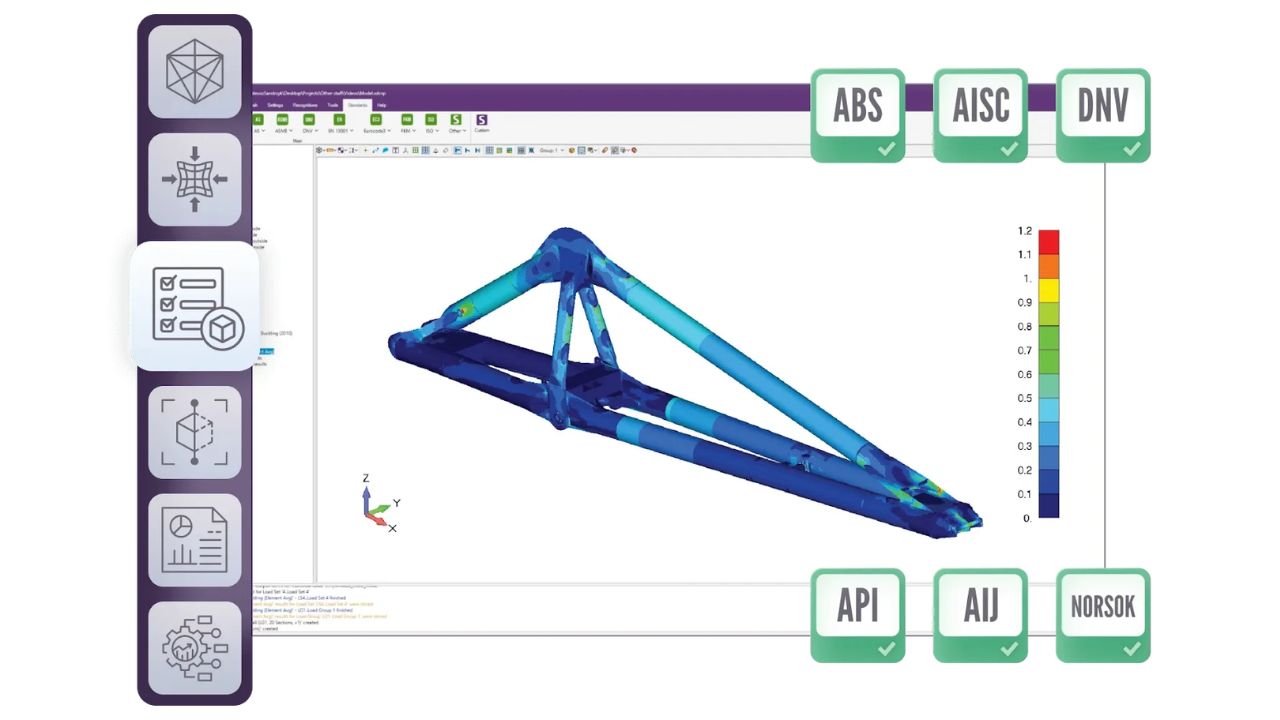
Modern structural verification software changes this entirely. Automated tools can take finite element results and check them against dozens of engineering standards (Eurocode, API 2A, DNV, AISC, ABS) without the engineer manually setting up each check. Members, welds, panels, and joints get recognized automatically, stresses get transformed into the right coordinate systems, and code checks run across thousands of load combinations in minutes rather than weeks.
The FEA software market reflects this shift. Valued at roughly $7.8 billion in 2026, it’s projected to nearly double to $14.7 billion by 2031. The growth isn’t coming from more people doing manual analysis. It’s coming from automation consuming repetitive work.
The results speak for themselves. Cosimtec, a Singapore-based offshore engineering firm, reported 70% time savings on report generation and 60% faster buckling checks after adopting automated verification workflows with SDC Verifier. Eight complex load cases, over 650 000 elements, and a 30% reduction in total project time. That’s not a theoretical benchmark.
Digital Twins and Structural Health Monitoring
Digital twins have graduated from buzzword to business case. The global digital twin market is expected to grow from €16.4 billion in 2025 to €240 billion by 2032, a compound annual growth rate of nearly 40%.
For structural engineering, digital twins mean something very specific: a continuously updated virtual model of a physical asset that reflects its actual condition based on inspection data, sensor readings, and operational loads. The FEA model doesn’t get archived after handover. It stays active, gets fed real data, and becomes the basis for every structural decision across the asset’s lifetime, from modification assessments to fitness-for-service evaluations.
Structural health monitoring is what makes this work in practice. Strain gauges, accelerometers, corrosion sensors, and regular inspection findings all feed back into the model. Consider a port gantry crane that’s been operating for 15 years. Traditional inspection schedules are calendar-based: inspect every X months regardless of actual wear. A digital twin approach flips this. Real load cycles replace assumed ones in the fatigue model. Corrosion data updates section properties. The result is a structure whose remaining life estimate is based on what actually happened to it, not what was assumed at the design stage.
That shift, from scheduled maintenance to condition-based decision-making, is where the real value sits. Engineers stop asking “is it time to inspect?” and start asking “where does the model say the damage is accumulating?”.
Structural Engineering Practices: 2020 vs 2026
| Area | 2020 | 2026 |
| FEA post-processing | Manual extraction to spreadsheets | Automated code checks across full model |
| Code verification | Standard-by-standard, engineer-driven | Multi-standard, software-automated |
| Reporting | Manual Word/PDF assembly, days per report | One-click regeneration in minutes |
| Collaboration | Local files, email-based review | Cloud platforms, real-time model sharing |
| Asset monitoring | Calendar-based inspections | Data-driven, digital twin-powered SHM |
Cloud-Based FEA and Distributed Engineering Teams
The pandemic proved that engineering teams don’t need to sit in the same office. But it also exposed how poorly traditional FEA workflows handle distributed collaboration.
Cloud-based analysis platforms solve two problems at once. First, compute: running large models with hundreds of load combinations no longer requires a local workstation with 128 GB of RAM. Cloud solvers scale on demand. Second, access: engineers in Rotterdam, Singapore, and Houston can work on the same model without emailing result files back and forth.
This matters especially for offshore and heavy lifting industries, where projects routinely involve multinational teams, multiple classification societies, and tight certification timelines. The ability to share a verified model with all code checks intact and reports regenerable removes an entire class of coordination failures.
AI in Structural Analysis
AI won’t replace structural engineers. But it will change what they spend their time on.
Pattern recognition is the most mature application today. AI models trained on thousands of FEA results can flag anomalies, identify stress concentrations that a human might miss in a model with hundreds of thousands of elements, and prioritize which load cases actually govern the design. That’s not replacing engineering judgment. That’s augmenting it with computational muscle.
Optimization is the next frontier. Generative design algorithms can explore thousands of geometric configurations, varying plate thicknesses, cross-section shapes, and weld placements to find the lightest structure that still passes all code checks. SDC Verifier’s Optimization Module works along similar lines, finding minimum-weight solutions across weld types, plate dimensions, and cross-sections while maintaining full code compliance.
“The engineering talent gap isn’t just a hiring problem. It’s a knowledge transfer crisis. With 184 000 engineers leaving the profession annually and only 166 000 entering, automation and AI become the only realistic mechanisms to preserve institutional expertise and maintain design quality at scale.” — Based on data from ACEC and ASCE
The broader simulation software market is projected to hit $36.2 billion by 2030. A significant portion of that growth is driven by AI-augmented analysis tools entering mainstream engineering workflows.
5 Structural Engineering Trends Reshaping the Industry
These aren’t predictions from a conference slide deck. They’re shifts already underway, visible in how leading firms operate today.
- Automated code verification replacing manual spreadsheet checks across all major standards
- Digital twins shifting structural monitoring from calendar-based inspections to data-driven maintenance
- Cloud FEA enabling real-time collaboration for multinational engineering teams
- AI-assisted optimization reducing structural weight while maintaining code compliance
- Integrated reporting workflows generating certification-ready documents in minutes, not days
Any one of these changes how a project gets delivered. Together, they redefine what a competitive engineering workflow looks like in 2026.
What Engineers Should Prepare For
Truth be told, the biggest risk for structural engineers isn’t that these technologies will take their jobs. It’s that the profession’s skillset requirements are shifting faster than university curricula can adapt.
Engineers who understand FEA theory but can’t navigate automated verification workflows will find themselves at a disadvantage. The ability to set up, validate, and critically evaluate automated code checks is becoming as fundamental as knowing how to read a bending moment diagram.
Three practical steps. Learn at least one modern verification platform, not just the FEA solver but the post-processing and code-checking layer on top of it. Get comfortable with digital twin concepts and how inspection data feeds back into structural models. And develop a working understanding of what AI can and can’t do in structural analysis, enough to ask the right questions when evaluating new tools.
The future of structural engineering isn’t about choosing between human expertise and software automation. It’s about combining them. The engineers and firms that figure this out first will have a structural advantage, in every sense of the word.
