


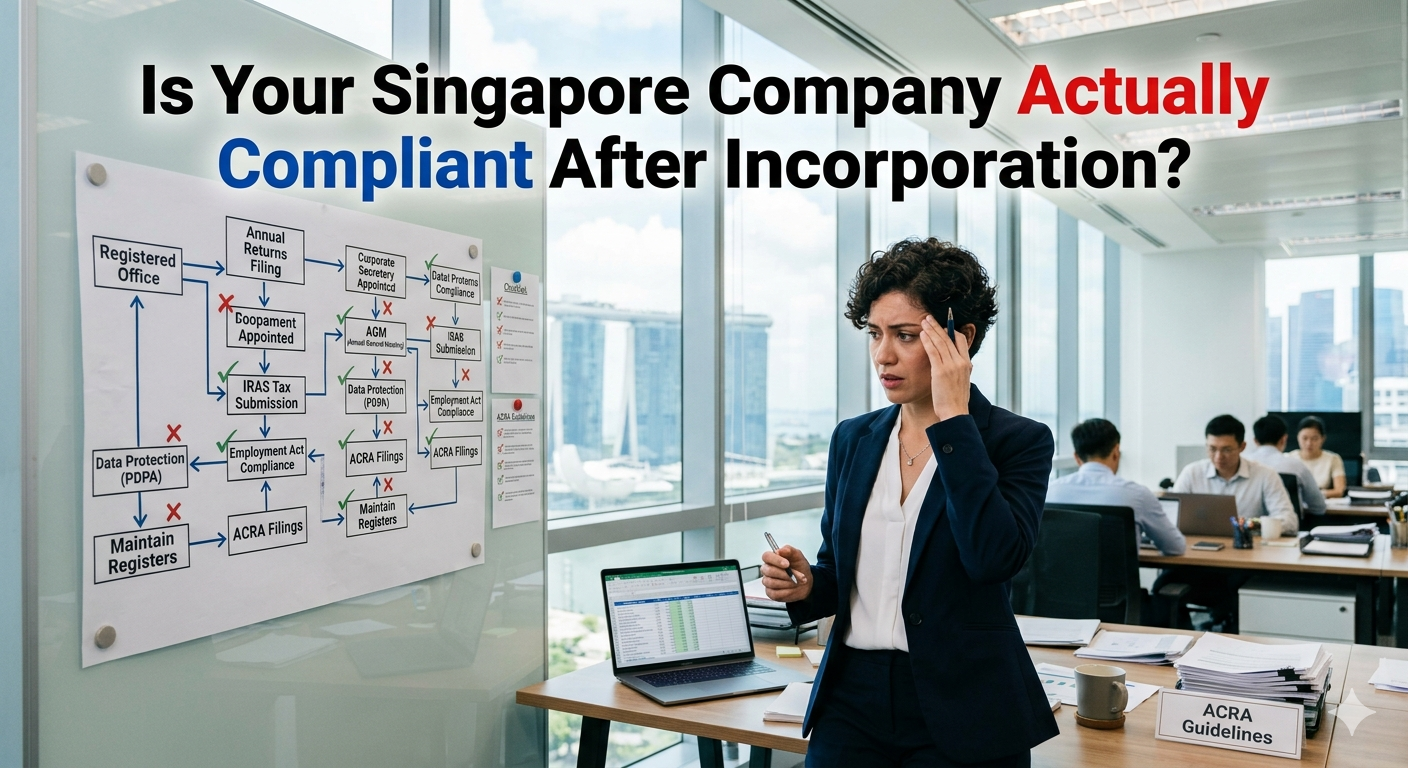
You Incorporated in Singapore. Now What?
Most business owners breathe a sigh of relief the moment their Singapore company is registered. And honestly? That feeling makes complete sense. Getting incorporated feels like crossing the finish line.
Here’s the thing — it is actually the starting line.
The real work begins after incorporation. Singapore is one of the world’s most business-friendly jurisdictions, but it runs on a strict compliance framework. Miss your deadlines, skip your filings, or misunderstand your obligations, and you could be looking at penalties, fines, or even striking off your company.
Nobody warns you about this part. So let us walk through exactly what happens after you incorporate — and what you absolutely cannot ignore.
The Hidden Compliance Calendar That Catches New Business Owners Off Guard
Singapore has a very specific set of post-incorporation requirements governed by the Accounting and Corporate Regulatory Authority (ACRA) and the Inland Revenue Authority of Singapore (IRAS). These are not optional. They are mandatory, and they have deadlines.
The problem is that most guides focus entirely on how to set up a company. Very few tell you what comes next.
Your Annual General Meeting (AGM) Obligation
Private companies in Singapore that are not exempt private companies must hold an AGM. Even for companies that qualify as exempt private companies, you still need to send financial statements to shareholders within five months of your financial year end.
Miss this, and ACRA can take action against your company and its directors.
Financial Statements and Audit Requirements
Not every Singapore company needs a statutory audit. Small companies — generally those with annual revenue under S$10 million, fewer than 50 employees, and total assets under S$10 million — may qualify for an audit exemption.
But you still need to prepare proper financial statements. That means engaging an accountant or a firm that understands Singapore’s Financial Reporting Standards.
Annual Return Filing with ACRA
Every Singapore company must file an Annual Return with ACRA. The deadline depends on whether your company is listed or unlisted, and whether you hold an AGM.
For most private companies, this must be filed within seven months of the financial year end if no AGM is held.
Corporate Tax: What IRAS Expects From You Every Year
Singapore’s corporate tax rate is a flat 17%. That sounds straightforward. But the actual compliance process involves several steps that trip up many business owners.
Estimated Chargeable Income (ECI)
Within three months of your company’s financial year-end, you must file your Estimated Chargeable Income with IRAS. Even if your company made no taxable income, you may still need to file a nil ECI.
This catches people off guard constantly. You have zero revenue, so you assume you have nothing to report. That assumption can lead to penalties.
Corporate Income Tax Return (Form C or Form C-S)
Depending on your company’s revenue and structure, you will file either Form C, Form C-S, or Form C-S Lite. The deadline is typically 30 November each year for paper filing, with e-filing deadlines varying.
Tax exemptions are available for new companies. For the first three years of assessment, qualifying new companies can enjoy a 75% exemption on the first S$100,000 of chargeable income. Do not leave this on the table.
A Quick Overview of Singapore’s Key Compliance Deadlines
| Obligation | Governing Body | Typical Deadline |
|---|---|---|
| Estimated Chargeable Income (ECI) | IRAS | Within 3 months of financial year end |
| Annual Return Filing | ACRA | Within 7 months of financial year end |
| Corporate Income Tax Return | IRAS | 30 November (paper) / varies (e-filing) |
| Financial Statements to Shareholders | ACRA | Within 5 months of financial year end |
| GST Returns (if registered) | IRAS | Quarterly, within one month of end of quarter |
| Payroll and CPF Contributions | CPF Board | By 14th of each month |
GST Registration — Do You Need It?
Here is a question many new business owners in Singapore get wrong.
GST registration is mandatory only once your taxable turnover exceeds S$1 million in a 12-month period. Below that threshold, it is voluntary. But voluntary registration can actually be beneficial in certain scenarios — particularly if you have significant input tax to claim.
The exception is if your business model involves exclusively zero-rated supplies. In that case, registration may work in your favour even if you are below the threshold.
Talk to a professional before making this call. Getting it wrong costs you more than the registration itself.
Company Secretary: Not Just a Formality
Every Singapore company must appoint a company secretary within six months of incorporation. This person — or firm — is not just an administrative role. The company secretary is responsible for ensuring your company meets all statutory filing requirements under the Companies Act.
The company secretary must be a natural person who is ordinarily resident in Singapore.
If you incorporated your company without securing a company secretary, this is urgent. Non-compliance here is a serious breach under Singapore law.
Piloto Asia provides company secretarial services as part of its comprehensive suite of business solutions. This means your compliance calendar is managed by people who live and breathe Singapore corporate law — not left to chance.
The Mistakes Most Foreign Business Owners Make
You might feel overwhelmed reading all of this. That is completely normal.
Most foreign entrepreneurs who set up companies in Singapore do so because of the attractive tax regime, strategic location, and ease of doing business. But they underestimate how much ongoing management is required.
The most common mistakes include missing ECI deadlines, failing to maintain proper accounting records throughout the year, assuming audit exemption means no financial reporting at all, and not registering for GST when they cross the threshold.
These are not minor oversights. ACRA and IRAS impose financial penalties for late or incorrect filings, and repeated non-compliance can result in director disqualification.
Why Ongoing Compliance Is Not a DIY Job
Some business owners try to manage Singapore compliance on their own. A few succeed. Most eventually realise the time cost is simply not worth it.
Singapore’s regulatory framework is rigorous by design. It is what makes Singapore a trusted global business hub. But that rigour demands attention to detail, local knowledge, and consistent follow-through.
This is exactly why Piloto Asia exists. As Singapore’s most comprehensive company incorporation and compliance service, Piloto Asia offers end-to-end support — from helping you incorporate company in Singapore all the way through tax filing, accounting, payroll, and corporate secretarial services. And unlike most providers, they back their accounting and bookkeeping services with a 30- to 60-day money-back guarantee. That kind of commitment is genuinely rare in this industry.
If you want to understand more about how Singapore’s business registration authority works, the ACRA Singapore guide from Piloto Asia breaks it down clearly.
Frequently Asked Questions
Do I need to file anything with ACRA if my company has no business activity? Yes. Even a dormant company in Singapore is required to file an Annual Return with ACRA and may still need to submit financial statements. Dormancy does not suspend your compliance obligations.
What happens if I miss the ECI filing deadline in Singapore? IRAS may issue a Notice of Assessment based on estimated figures, which could result in a higher tax bill. Penalties for late filing can also apply. It is best to file on time, even if your chargeable income is zero.
Can a foreigner be a company secretary in Singapore? No. Under the Singapore Companies Act, the company secretary must be a natural person ordinarily resident in Singapore. Foreigners based overseas cannot fulfil this role, which is why most foreign business owners engage a local firm to handle this.
How long do I need to keep my company’s accounting records in Singapore? Singapore law requires companies to retain accounting records and supporting documents for at least five years from the end of the financial year to which they relate.
Do Not Let Compliance Be the Thing That Breaks Your Singapore Dream
Incorporating in Singapore is one of the smartest business moves you can make. The infrastructure, the tax environment, the access to global markets — it is all real.
But incorporation is just the beginning. The companies that thrive here are the ones that take compliance seriously from day one.
Start right. Stay compliant. And if you want a trusted partner who handles all of it under one roof, reach out to Piloto Asia — Singapore’s go-to service for incorporation, compliance, accounting, and everything in between.
