


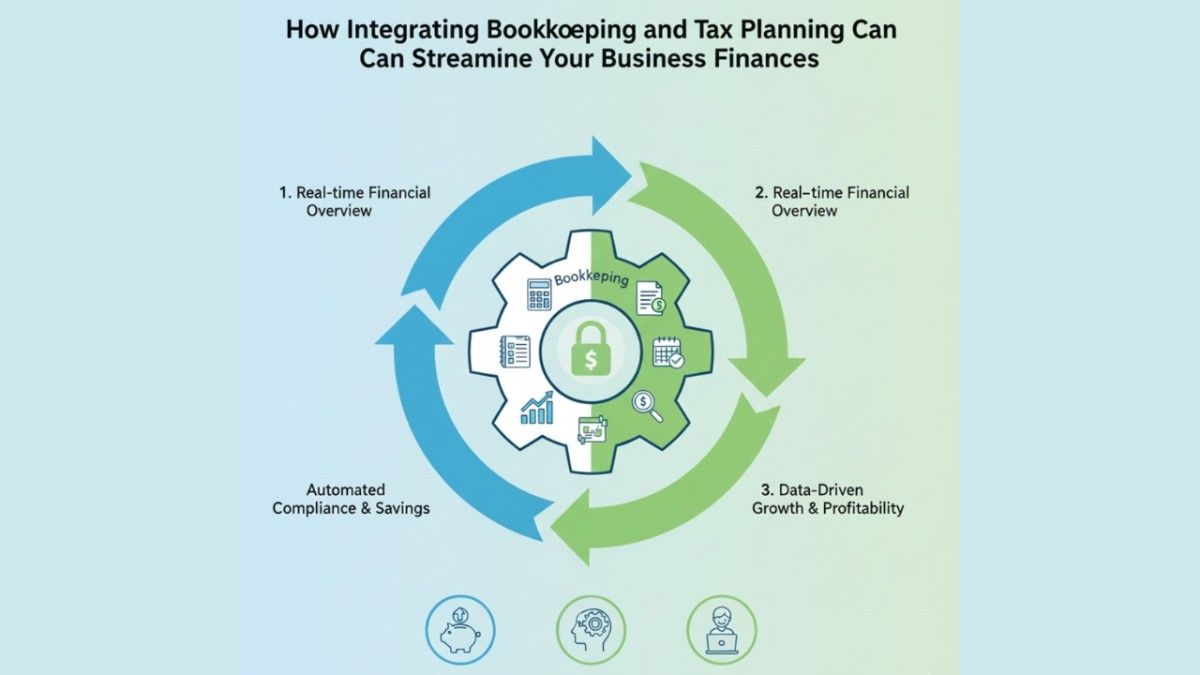
Managing your business finances shouldn’t feel like juggling disconnected pieces of a puzzle. Yet for many UK business owners, that’s exactly what it becomes. Bookkeeping sits in one corner, VAT returns in another, and tax planning is only revisited when deadlines loom. When these functions operate separately, they create gaps, delays, and unnecessary stress — especially around key HMRC reporting dates.
The reality is simple: your business runs more smoothly when your financial processes work together. Integrating bookkeeping, VAT management, and tax planning gives you a complete, real-time view of your financial position. It reduces errors, unlocks opportunities for smart tax savings, and provides the clarity needed to make informed decisions all year round.
In this blog, we explore how integrated financial services can transform your business operations, why they matter more than ever, and how the right combination of bookkeeping & VAT services with proactive tax planning services can bring long-term financial stability.
Why Integration Matters: The Problem With Separate Financial Processes
For many businesses, bookkeeping and tax planning operate independently — handled by different providers, managed on different timelines, or completed only when deadlines demand it. While this may appear to work at the surface level, it often results in inefficiencies that slow your business down.
1. Fragmented Processes Lead to Inconsistencies
When your bookkeeping is handled by one party and tax planning by another, the information used for tax forecasting often lags behind reality. If your books aren’t up to date, your accountant cannot accurately estimate liabilities or identify tax-saving opportunities.
This lack of alignment leads to:
- Delayed reporting
- Guesswork during tax season
- Inaccurate or incomplete VAT submissions
- Errors that require corrections
Small inconsistencies eventually snowball into costly mistakes.
2. Limited Visibility Creates Uncertainty
When financial data is updated only every few weeks or months, it becomes almost impossible to forecast tax bills or cash flow accurately. Businesses often discover issues only when it’s too late to act — for example, realising they owe more VAT or income tax than expected, but don’t have the funds set aside.
3. Missed Opportunities for Tax Savings
Tax planning works best when it’s proactive. But if your records aren’t current, your tax advisor cannot identify:
- Capital allowances
- Available reliefs
- Optimal timing for purchases or investments
- Opportunities to reduce taxable profits
- VAT schemes that may benefit your business
Much of successful tax planning relies on timing, and timing depends on accurate financial data.
What Integration Looks Like: Combining Bookkeeping, VAT, and Tax Planning
Rather than viewing bookkeeping and tax planning as mutually exclusive activities, progressive business enterprises have integrated them. This combined model makes all financial decisions supported with real-time information.
Here’s what a modern, streamlined setup looks like.
1. Real-Time, Accurate Bookkeeping
Bookkeeping is the foundation of all your financial operations. When handled consistently, it gives you:
- Up-to-date financial records
- Accurate categorisation of income and expenses
- Clean data for VAT and tax calculations
- A reliable picture of business performance
Digital accounting tools can automate much of the process, but the real value comes from consistent, expert oversight.
2. Seamless VAT Management
VAT can be one of the most challenging parts of compliance for UK businesses. Errors in VAT returns typically arise from:
- Incorrect bookkeeping
- Missing invoices
- Misclassified transactions
- Late reconciliations
Integrated bookkeeping & VAT services ensure that every transaction is entered correctly, reducing the risk of penalties and giving you confidence that your VAT submissions are always accurate and on time.
3. Proactive, Data-Driven Tax Planning
Tax planning shouldn’t be a once-a-year activity. When your tax advisor has consistent access to accurate financial data, they can:
- Forecast future liabilities
- Advise on reliefs and allowances when they matter
- Guide investment timing
- Help reduce taxable profits in legitimate ways
- Prevent unpleasant surprises
This is where integration of bookkeeping & VAT with tax planning truly adds value. The process becomes continuous, not reactive.
The Key Benefits of Integrating Bookkeeping, VAT, and Tax Planning
Bringing these financial functions together offers several long-term advantages.
1. Stronger Cash Flow Forecasting
One of the biggest challenges for a growing business is cash flow. Integrated financial services allow you to:
- Forecast upcoming VAT bills
- Estimate tax liabilities months in advance
- Plan spending with confidence
- Avoid tight spots before they become crises
This helps you understand not just where your business stands — but where it’s heading.
2. Early Identification of Tax-Saving Opportunities
When your records are up to date, your accountant can identify:
- Allowable expenses
- R&D relief opportunities
- VAT schemes suited to your business
- Timely capital investment advantages
- Dividend vs salary optimisation
Good tax planning relies on good data. Integration ensures those opportunities aren’t missed.
3. Reduced Risk of HMRC Penalties
Inaccurate VAT returns, late submissions, and miscalculations can all lead to penalties. With integrated services:
- Bookkeeping is always accurate
- VAT is filed correctly
- Tax estimates are based on real numbers
- Compliance becomes straightforward
This reduces risk and gives you peace of mind.
4. Greater Efficiency and Less Admin
When your financial processes work together:
- You deal with one team, not several
- Data flows seamlessly from bookkeeping to tax planning
- There’s no need to repeat information
- You save hours of admin every month
It’s simpler, smoother, and much more efficient.
5. A Smoother Year-End Process
Once your books are current on a monthly basis and are tax planning, the year-end does not seem like a scramble. One does not have to go out and search for old documents or balance multiple months of transactions; everything is already in the right place and right time.
How Integrated Services Improve Day-to-Day Operations
Beyond tax and compliance, integrated bookkeeping and tax planning improve everyday business decisions.
1. One Clear Financial Picture
Instead of switching between software, spreadsheets, or multiple advisors, you work with one unified system. This gives you:
- A single source of truth
- Real-time financial clarity
- Consistent reporting you can rely on
2. Predictable Workflows and Reporting
Monthly check-ins, timely VAT submissions, and ongoing tax forecasting mean nothing falls through the cracks.
3. Better Business Decisions
With integrated services, you can answer key questions confidently:
- Can I afford to hire another employee?
- Is now the right time to invest in equipment?
- What tax implications will this purchase have?
- Is cash flow strong enough to support expansion?
Good decisions start with good information — and that comes from integration.
Why Annual Accounts Alone Are Not Enough
Annual accounts show history, not the present. They reflect:
- What has already happened
- Issues that may now be too late to fix
- Tax liabilities that cannot be changed
Integrated bookkeeping and tax planning, on the other hand, give you:
- Continuous insight
- Monthly reporting
- Real-time forecasting
- Early intervention opportunities
This shift from reactive to proactive management is what sets modern businesses apart.
How Julian Hobbs Helps You Streamline Your Financial Operations
We realise that the owners of a business would expect to know that their finances are safe and secure at Julian Hobbs. That is why we provide fully integrated bookkeeping and VAT services together with the strategic tax planning services, which are aimed at helping your business throughout the year.
1. Comprehensive Bookkeeping & VAT Services
We ensure your records are always accurate, organised, and compliant. This includes:
- Monthly bookkeeping
- VAT return preparation and filing
- Bank reconciliations
- Digital recordkeeping
- Real-time financial reports
2. Ongoing Tax Planning Services
Our proactive approach helps you:
- Forecast liabilities
- Reduce tax bills legitimately
- Understand reliefs and allowances
- Plan investments more effectively
- Stay compliant without the stress
3. A Unified Financial System
Instead of juggling multiple providers, you get one coordinated service — giving you a fully streamlined financial process from start to finish.
Conclusion — A Smarter, Simpler Way to Manage Your Finances
It is more than time-saving to integrate your bookkeeping, VAT management and tax planning. It is the establishment of a trustworthy financial environment that gives your business solid and safe growth. Real-time data, proactive suggestions, and smooth processes will enable you to minimise errors, prevent surprises and make superior decisions throughout the year.
Integration will make you have a financial system that will work with you and not one that will hinder you.
Ready to Transform Your Business Finances?
Contact Julian Hobbs today and get to know how VAT, tax planning and bookkeeping services can be integrated to ensure your business meets the compliant, tax-efficient and financial requirements throughout the entire year.
