


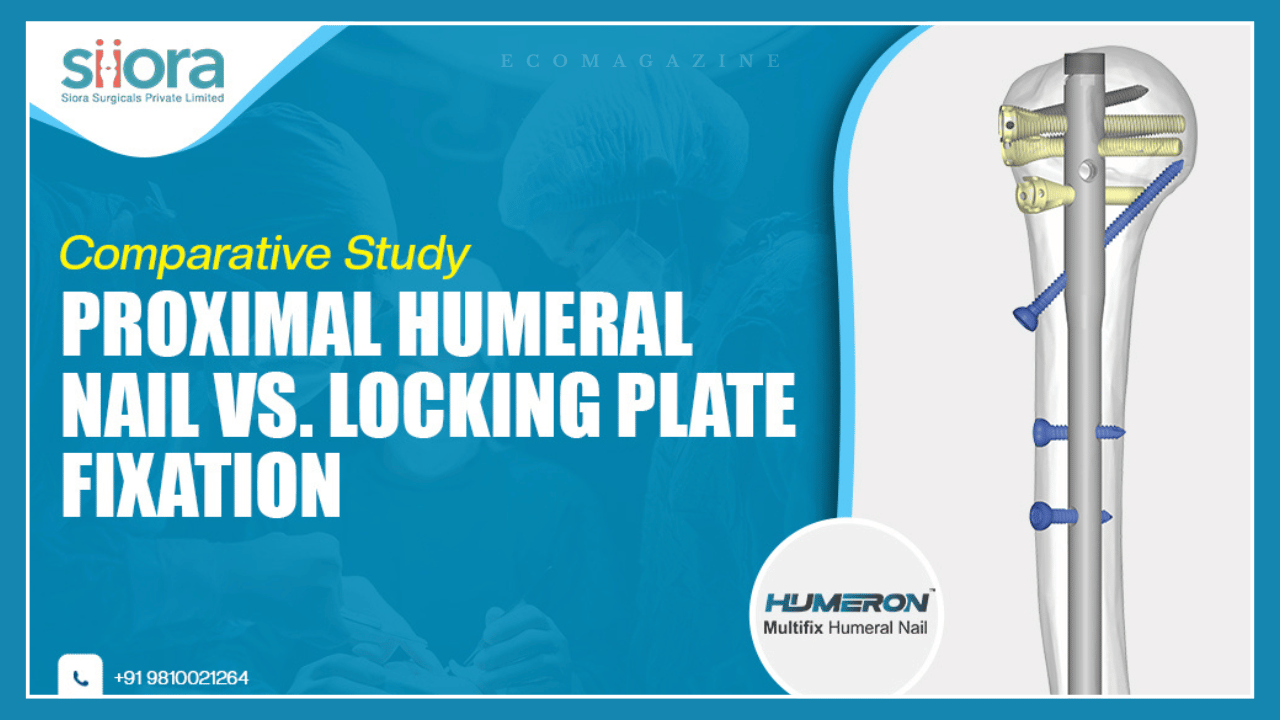
A bad fall onto your shoulder, and suddenly you’re faced with a serious injury: a proximal humerus fracture. This is a break at the top of your arm bone, right at the ball-and-socket joint of your shoulder. It’s a notoriously tricky fracture to fix, especially in older patients with weaker bone. When surgery is needed, the surgeon has two main tools in their arsenal: a locking plate that goes on the outside of the bone, or a long proximal humeral nail that goes down the inside. This isn’t a matter of flipping a coin. It’s a strategic choice between two excellent, but very different, philosophies of fixation.
The Case for the Plate: The “Open Book” Method
The classic approach is to use a locking plate. The surgeon makes an incision over the front of the shoulder, directly exposing the fracture. This “open” approach has one massive advantage: direct visualization.
Think of a shattered porcelain vase. You wouldn’t try to glue it back together from the inside. You’d want to lay all the pieces out, see how they fit, and carefully put them back together. That’s the philosophy behind plating. Proximal humerus fractures are often complex, involving the “tuberosities”—the all-important bony bumps where your rotator cuff tendons attach. To ensure your shoulder functions properly after surgery, the surgeon must place these pieces back in their correct positions. A plate allows the surgeon to directly see, grasp, and reassemble this complex jigsaw puzzle, ensuring an anatomical reduction. Once the pieces are perfectly aligned, the plate is applied to the outside of the bone to hold it all together.
The Case for the Nail: The Internal Scaffold
A proximal humeral nail is a completely different strategy. It’s a minimally invasive approach. Instead of a long incision over the shoulder, the surgeon makes a small cut at the very top of the shoulder and inserts a long metal rod down the hollow center of the humerus. The surgeon then passes screws through the bone and the nail to lock the fracture fragments in place.
The nail has two huge biomechanical advantages:
It’s a Load-Sharing Device
Because the nail sits in the center of the bone, it aligns with the natural axis of weight-bearing. It shares the load with the bone, making it incredibly strong and resistant to bending forces. This is a massive advantage in the soft, osteoporotic bone of an elderly patient, where screws from a plate might struggle to get a good grip.
It’s Kinder to the Biology
Inserting the nail causes minimal disruption to the bone’s blood supply and the surrounding tissues. Less surgical trauma can mean a lower risk of certain complications, like infection or bone death (avascular necrosis).
The Head-to-Head: How a Surgeon Decides?
So, when does a surgeon choose one over the other? It comes down to the specific fracture pattern and the patient.
- Is the “ball” of the shoulder shattered into many pieces?
Advantage: Plate. The ability to open up the fracture and directly piece together the joint surface is invaluable. It’s the best way to ensure the rotator cuff attachments are perfectly restored. - Is the bone quality very poor (osteoporosis)?
Advantage: Nail. The superior biomechanics and load-sharing properties of a nail often make it a more stable and reliable choice in weak bone, reducing the risk of screws pulling out. - Does the fracture extend far down the shaft of the arm?
Advantage: Nail. A single intramedullary nail can easily stabilize the entire length of the bone, whereas a plate would need to be incredibly long, requiring a huge incision. - Is the patient very frail with multiple medical problems?
Advantage: Nail (potentially). The less invasive nature of the nail surgery can sometimes mean a shorter operating time and less blood loss, which can be a significant benefit for a high-risk patient.
The Verdict
There is no universal “winner.” A locking plate or a variable angle locking plate is an outstanding tool for achieving a perfect anatomical fix of a complex joint fracture. A humeral nail is a biomechanical powerhouse that provides incredible stability in weak bone. The surgeon’s job is to analyze your specific fracture, your bone quality, and your overall health to choose the implant that will give you the most stable, reliable fix and the best possible shot at regaining a functional, pain-free shoulder.
