


The Illusion of the “Green Office”
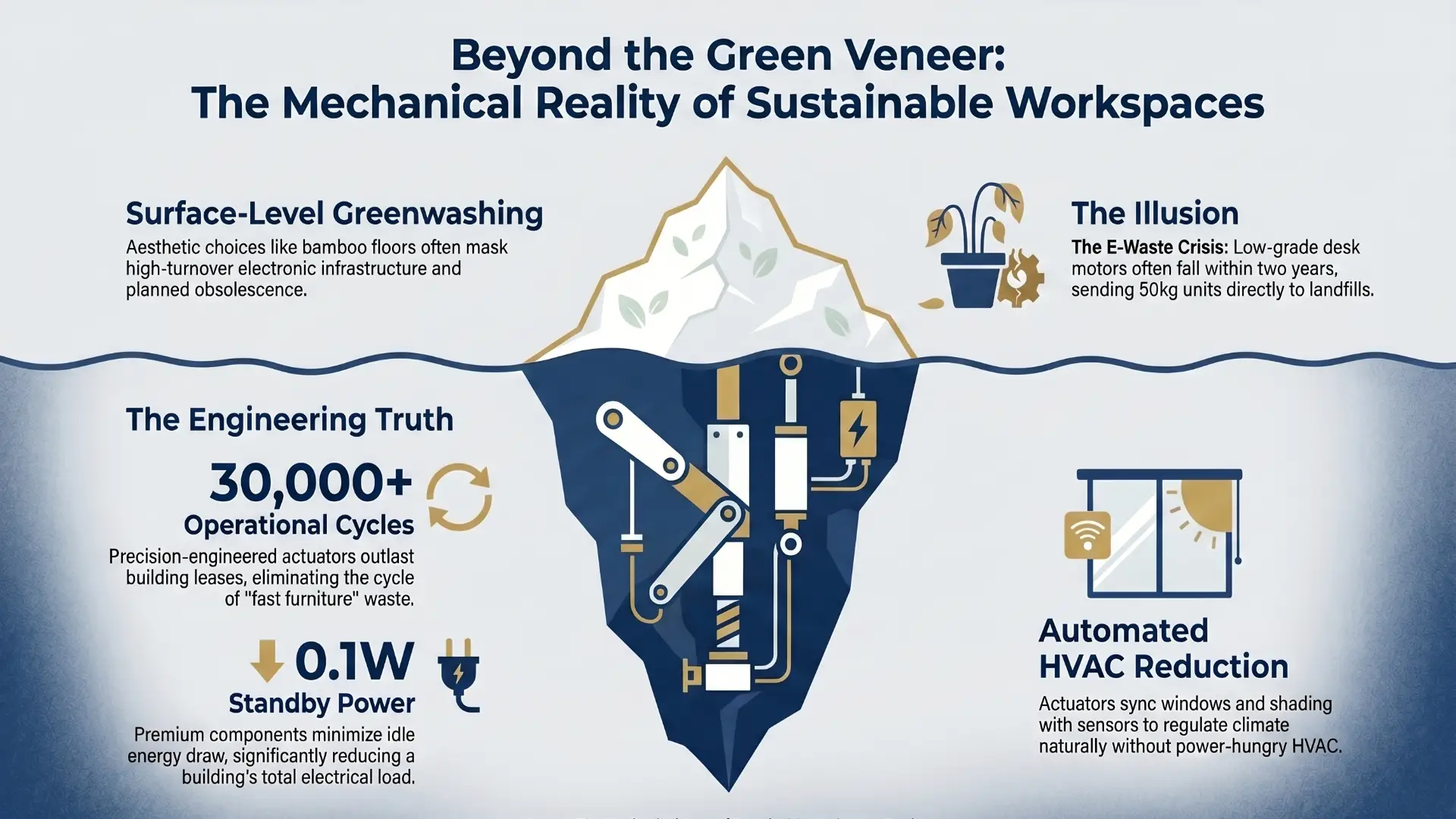
Modern corporate spaces frequently parade their environmental credentials through highly visible, aesthetic choices. Bamboo flooring, recycled paper products, and living green walls look fantastic on a company brochure.
However, these surface-level upgrades often create a mere illusion of sustainability if the underlying infrastructure relies on “planned obsolescence.”
As organizations move toward strict Net-Zero targets, they are realizing that a truly green building is defined by what happens behind the walls and under the desks.
Many companies celebrating their corporate ESG strategies fail to account for the heavy electronic infrastructure powering their dynamic, modern workspaces.
If a company fills its headquarters with smart, motorized sit-stand desks that break down within two years, the resulting electronic waste negates any carbon savings from those recycled coffee cups.
E-Waste and the Lifespan of Smart Office Furniture
The environmental cost of ‘fast furniture’ is staggering, particularly when cheap, mass-produced electronic components inevitably fail.
When a low-grade motor inside a heavy sit-stand desk burns out, the entire unit—often weighing upwards of 50 kilograms—is frequently sent straight to the local landfill.
To combat this hidden surge in electronic waste, environmentally responsible procurement teams are rapidly pivoting away from disposable workplace hardware.
Instead, they prioritize smart infrastructure powered by a reliable electric actuator manufacturer Hoodland that utilizes precision gear meshing to guarantee a lifespan exceeding 30,000 operational cycles.
This extreme level of durability ensures the mechanical core of the workspace actually outlasts the building’s lease, drastically cutting down on cyclic, unnecessary waste.
Energy Efficiency in Micro-Movements
Beyond simple physical durability, the internal engineering of smart furniture significantly impacts a building’s overall energy load.
Poorly manufactured motors suffer from high internal friction, requiring excessive electrical current just to perform basic vertical movements.
Conversely, precision-engineered linear actuators move heavy loads with minimal resistance, directly lowering the active energy draw during operation.
More importantly, premium components are designed to minimize standby power consumption—often drawing less than 0.1W when idle.
When multiplied across thousands of workstations in a high-rise corporate headquarters, this micro-efficiency results in massive annual energy savings.
Automated Climate Control: Actuators in Green Architecture
The application of sustainable linear motion technology extends far beyond ergonomic office desks.
In fact, these exact micro-mechanics are fundamental to the circular economy principles in green building and modern structural design.
Smart buildings utilize heavy-duty actuators to automatically open and close large louver windows, roof vents, and exterior solar shading.
By synchronizing these automated movements with internal temperature sensors and external weather data, buildings can naturally regulate their climate.
This dynamic, automated airflow drastically reduces the facility’s reliance on power-hungry HVAC systems, slashing daily operational carbon emissions.
The Carbon Footprint of Workspace Procurement
When organizations audit their environmental impact, the lifecycle of their internal office equipment is frequently a glaring blind spot.
However, the continuous cycle of buying, breaking, and replacing smart equipment significantly inflates a company’s carbon footprint.
Specifically, it drives up Scope 3 emissions—the indirect emissions that occur within a company’s supply chain and procurement lifecycle.
International environmental audits and comprehensive reports detailing the escalating global e-waste crisis underscore a harsh reality for the corporate sector.
Shifting toward long-lasting, repairable, and energy-efficient infrastructure is no longer just a smart financial decision; it is a critical ecological mandate.
True sustainable procurement requires facility managers to demand transparent lifecycle data and verified durability testing from every hardware vendor.
By investing in high-cycle, durable mechanics, businesses actively prevent toxic heavy metals and plastics from poisoning local ecosystems.
Key Takeaways
| Area | Key Takeaway | Impact/Data |
| E-Waste | Buy 30k-cycle motors | Save 50kg per desk |
| Power | Use precision gears | < 0.1W idle draw |
| Climate | Automate smart vents | Cut HVAC carbon |
| Scope 3 | Audit gear lifespan | Stop toxic e-waste |
Conclusion: True Sustainability is Built into the Gears
Achieving authentic corporate sustainability is a complex structural challenge, not a marketing campaign.
It requires business leaders and ESG officers to look past the superficial greenery and interrogate the physical hardware powering their daily operations.
Real environmental responsibility starts from the inside out, down to the smallest motor and the tightest gear mesh.
By demanding uncompromising durability in mechanical components, we can effectively dismantle the throwaway culture of modern office tech and build workspaces that truly respect the planet.
