

Transitioning from a localized specialty roaster to a regional distributor requires more than exceptional beans. As order volumes increase, brands must maintain strict quality control while fulfilling much larger commercial contracts.
The transition from small-batch craftsmanship to high-volume commercial production is often where scaling brands falter. Without the right infrastructure, rapid growth can quickly compromise both product integrity and operational profitability.
To survive this transition, facility managers and coffee entrepreneurs are increasingly turning to advanced industrial automation. By integrating smart packaging systems, operations can scale seamlessly while preserving the artisanal quality that built the brand’s reputation.
The Growth Bottleneck for Emerging Coffee Roasters
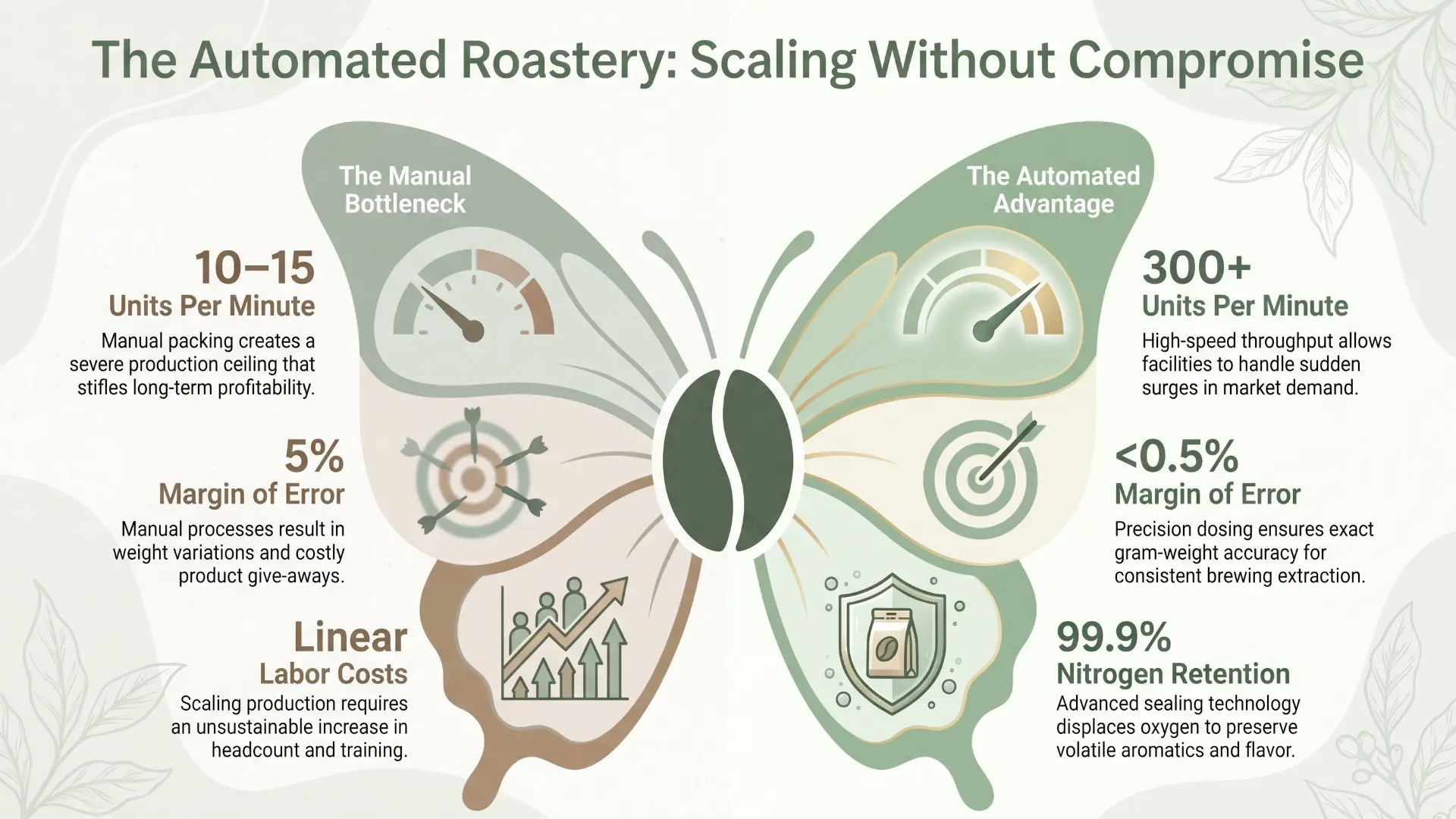
For emerging roasters, relying on manual or semi-automated packaging lines creates a severe bottleneck that stifles long-term profitability. High labor costs quickly eat into profit margins, especially when factoring in the required training, turnover rates, and human error.
A production line dependent on manual weighing simply cannot scale efficiently without an unsustainable increase in headcount. Furthermore, manual processes inherently struggle with consistency across shifts.
This ultimately leads to variations in bag weights and seal integrity. These inconsistencies not only result in costly product give-aways but also damage brand reputation if consumers receive improperly sealed batches.
The Freshness Factor: Overcoming Oxygen Exposure
When scaling production, preserving the volatile aromatics of freshly roasted coffee is the biggest technical hurdle. Exposure to oxygen rapidly degrades flavor, making advanced sealing technology non-negotiable for premium brands.
Modern automated equipment solves this by integrating precision Nitrogen Flushing during the sealing process to displace residual oxygen. For instance, industrial SANEU engineered by specialized manufacturers like SANEU can consistently achieve nitrogen retention levels of up to 99.9%.
This advanced capability ensures that the coffee maintains its peak flavor profile and significantly extends shelf life without compromising high-speed throughput.
Choosing the Right Automation for Your Product Lines
Selecting the right equipment requires a deep understanding of your current product mix and anticipated future offerings. Operations managers must evaluate machinery based on overall equipment effectiveness and format flexibility.
To understand the sheer operational difference, consider the following baseline metrics:
Manual vs. Automated Packaging Output Comparison
| Production Method | Units per minute (UPM) | Margin of error (%) | Labor cost impact |
| Manual Packing | 10 – 15 UPM | 3.0% – 5.0% | High (Scales linearly with output) |
| Semi-Automated | 30 – 50 UPM | 1.0% – 2.0% | Medium (Requires dedicated operators) |
| Fully Automated | 150 – 300+ UPM | < 0.5% | Low (One operator manages multiple lines) |
Single-Serve Pods (K-Cup & Nespresso Systems)
The demand for convenience has driven explosive growth in the Single-Serve Pods market, creating unique challenges for production facilities. Manufacturing these capsules requires microscopic precision, as even a fraction of a gram off-target can ruin the brewing extraction.
High-speed automation addresses this by utilizing highly sensitive load cells and automated dosing systems. Quality automated equipment guarantees:
- Precision Dosing: Exact gram-weight accuracy per pod to guarantee extraction and flavor consistency.
- Seal Integrity: Ultrasonic or advanced thermal sealing to prevent leaks and blowouts during high-pressure brewing.
- Format Flexibility: The mechanical ability to swap tooling quickly to accommodate different market formats.
VFFS and Stick Packs for Bulk Products
For wholesale distribution, instant coffee, and bulk whole beans, VFFS (Vertical Form Fill Seal) machines remain the industry standard. These systems pull a continuous roll of flat film, forming it into a bag, filling it, and sealing it in one seamless, high-speed motion.
VFFS automation drastically reduces material waste and allows for rapid changeovers between different bag sizes and product weights. When paired with multi-head weighers, these machines can handle everything from 5-pound wholesale bean bags to single-serve instant coffee stick packs.
The Shift Towards Sustainable Packaging Materials
Today’s consumers demand environmental accountability alongside premium quality, forcing brands to completely rethink their supply chains. This shift is driving a rapid transition from traditional single-use plastics towards Compostable materials and bio-based films.
However, running sustainable materials on legacy equipment often leads to severe operational nightmares. Compostable films are notoriously sensitive to heat and tension, often tearing or failing to seal properly on rigidly calibrated, older machines.
Upgrading to modern automation provides the dynamic temperature control and gentle film-handling necessary to process these eco-friendly materials efficiently without sacrificing speed.
Future-Proofing Your Facility’s Operations
Investing in advanced packaging infrastructure is no longer just a scalable advantage; it is a baseline requirement for survival. With the global coffee market continuing to expand at an unprecedented rate, facilities must be equipped to handle sudden surges in demand.
Upgrading to modular, software-driven equipment allows operations managers to minimize downtime, train staff more effectively, and adapt to rapidly shifting consumer trends without needing to overhaul the entire production line.
Ultimately, automation allows coffee businesses to eliminate manufacturing friction and refocus their capital on sourcing, roasting, and growing their market share.
