


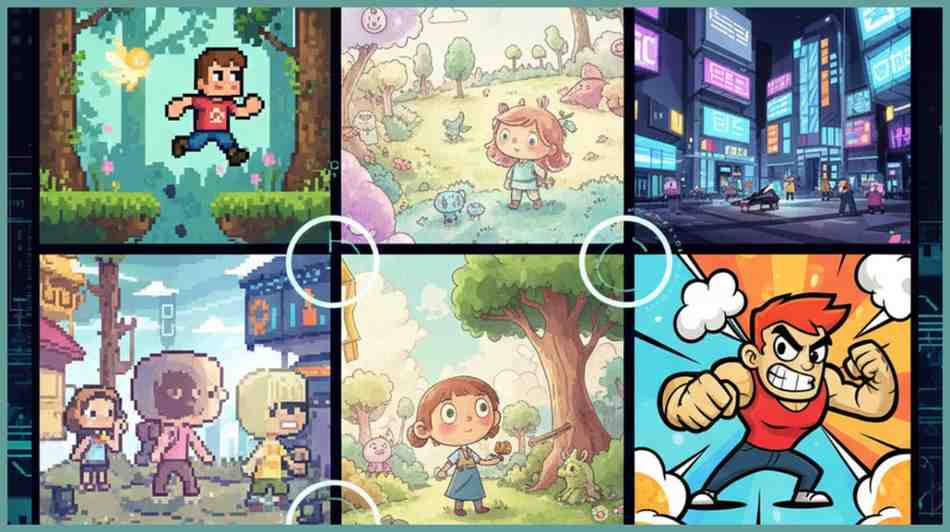
The game launches on Steam. Within hours, wishlists explode. Players share screenshots across social media. Streamers fight for early access. What creates this instant magnetism? Not photorealistic graphics or massive budgets. The answer lies in distinctive 2D art styles that capture hearts before players even hit the start button. Visual identity determines whether games drown in the endless scroll or rise above the noise demanding attention.
According to Cognitive Market Research, the pixel game market is projected to expand at approximately 11.5% CAGR between 2024 and 2031, demonstrating that 2D aesthetics continue gaining momentum rather than fading into nostalgia. This growth reveals a fundamental truth—players crave artistic vision over technical spectacle. Understanding which 2D art styles resonate most with audiences helps developers make informed creative decisions that balance artistic expression with commercial viability.
Why 2D Art Styles Matter for Indie Success
Indie developers face brutal competition. Thousands of games launch monthly on Steam alone. Standing out demands instant visual recognition that communicates genre, mood, and gameplay feel within seconds. Strong 2D game art styles achieve this immediately, creating memorable first impressions that translate into wishlists, purchases, and word-of-mouth promotion.
Budget constraints make 2D particularly attractive for small teams. Unlike 3D assets requiring specialized modeling, rigging, and animation skills, many 2D art services offer faster production pipelines that scale with limited resources. This accessibility explains why passionate solo developers can compete visually against teams ten times their size through smart style selection and execution.
Visual style profoundly influences emotional response. Abstract minimalism creates contemplative atmospheres. Vibrant cartoon aesthetics generate joy and approachability. Dark hand-drawn styles evoke tension and mystery. Players form instant connections based on artistic direction that aligns with their preferences and mood desires. Smart developers leverage these psychological associations deliberately.
The best 2D art styles transcend decoration—they reinforce gameplay mechanics, narrative themes, and overall experience cohesion. When visual presentation and game design work in harmony, players immerse deeply in worlds that feel intentionally crafted rather than arbitrarily designed.
Pixel Art: The Timeless Champion
Why Pixel Art Continues Dominating
Pixel art maintains its position as the undisputed king of indie aesthetics. Games like Stardew Valley, Celeste, and Undertale proved pixel visuals drive mainstream success despite—or perhaps because of—their retro simplicity. This style taps into nostalgia while offering modern developers practical advantages that explain its sustained popularity.
The deliberately limited resolution forces clarity. Every pixel carries intentional meaning. This constraint eliminates visual clutter, focusing player attention on meaningful gameplay elements rather than distracting detail. Characters remain instantly recognizable. Environments communicate navigation clearly. Mechanics feel immediately understandable through simplified visual language.
Key advantages of pixel art include:
- Development efficiency allowing small teams to create substantial content
- Cross-platform compatibility requiring minimal hardware specifications
- Emotional nostalgia connecting with multiple generational demographics
- Visual clarity that emphasizes gameplay over graphical realism
- Budget-friendly production enabling ambitious scope within resource constraints
Modern Pixel Art Evolution
Contemporary pixel art transcends simple 8-bit or 16-bit imitation. Modern implementations blend classic aesthetics with advanced lighting effects, particle systems, and smooth animations impossible on original hardware. This fusion creates visually striking results that honor retro roots while embracing current technical capabilities.
Developers now layer pixel graphics with dynamic lighting that casts realistic shadows, reflective water surfaces responding to environment changes, and weather effects adding atmospheric depth. These enhancements maintain pixel aesthetic integrity while dramatically increasing visual appeal to audiences expecting modern polish alongside retro charm.
Hand-Drawn Art: Crafted Authenticity
The Power of Artisanal Visuals
Hand-drawn animation represents the opposite extreme from pixel art’s technical precision. Every frame carries visible human touch—slight imperfections, organic line variation, textural richness impossible to achieve through purely digital means. Games like Cuphead, Hollow Knight, and Gris demonstrate how hand-drawn aesthetics create distinctive identities impossible to replicate through templates or procedural generation.
This style demands significant time investment. Artists painstakingly craft individual frames, paint detailed backgrounds, and refine character expressions until they convey intended emotions perfectly. The result justifies effort—games using hand-drawn art stand out immediately in crowded marketplaces as unique creative visions rather than derivative entries following established templates.
Production Considerations
Hand-drawn production scales differently than other styles. While initial setup requires substantial artistic skill, the approach suits narrative-focused games where visual storytelling takes precedence over extensive content volume. Adventure games, platformers with limited character rosters, and atmospheric exploration titles benefit most from hand-drawn investment.
Many successful indie teams combine hand-drawn key visuals with more efficiently produced background elements. Characters and critical story moments receive full artisanal treatment while environmental tiles use streamlined workflows. This hybrid approach balances distinctive visual identity with practical production realities.
Flat Design and Minimalism: Less Is More
The Appeal of Simplicity
Minimalist flat design strips visuals to essential elements—simple shapes, limited color palettes, clean silhouettes. Games like Thomas Was Alone, Reigns, and Monument Valley prove that restraint creates elegance. This aesthetic choices particularly suits puzzle games, abstract experiences, and titles prioritizing conceptual design over realistic representation.
Flat design’s geometric clarity ensures perfect readability across all screen sizes and resolutions. Mobile developers particularly favor this approach because simple shapes remain crisp on small displays while requiring minimal storage and processing power. The style ages gracefully—geometric abstraction rarely looks dated compared to failed attempts at realism.
Strategic Color Use
Limited color palettes define flat design success. Carefully selected hues create mood, guide attention, and establish visual hierarchy without cluttering screens with competing elements. Bold contrasts ensure clarity. Harmonious schemes establish atmosphere. Strategic accent colors highlight interactive elements or important information.
This constraint forces intentional design decisions. Every color choice carries purpose rather than adding arbitrary variety. Players subconsciously learn visual language as consistent colors signal consistent meanings throughout gameplay experiences.
Vector Art: Scalable Sophistication
Technical Advantages
Vector graphics use mathematical curves rather than pixel grids, enabling infinite scaling without quality loss. This technical property provides practical benefits for 2D art services working across multiple platforms with varying resolutions. Assets created once remain crisp whether displayed on mobile phones or 4K monitors.
The clean, sharp aesthetic of vector art suits specific genres particularly well. Strategy games benefit from clear unit distinction. Card games achieve elegant presentation. Minimalist adventures create stylized worlds. The mathematical precision underlying vector graphics produces consistent, polished results that feel deliberately refined.
Production Workflows
Vector workflows differ significantly from raster-based approaches. Artists work with shapes, paths, and anchor points rather than pixels or brush strokes. This method particularly suits developers comfortable with graphic design software rather than traditional illustration tools. The learning curve differs but rewards mastery with flexible, endlessly editable assets.
Many indie teams appreciate vector art’s revision-friendly nature. Adjusting colors, scaling elements, or refining shapes occurs non-destructively. This flexibility accelerates iteration during development when design requirements frequently evolve based on testing feedback.
Comparing Style Characteristics
| Art Style | Production Speed | Technical Requirements | Best Suited For | Player Appeal |
| Pixel Art | Fast to moderate | Low hardware demands | Retro games, roguelikes, platformers | High nostalgia factor, broad demographic |
| Hand-Drawn | Slow, labor-intensive | Significant artistic skill | Narrative adventures, atmospheric platformers | Strong emotional connection, artistic appreciation |
| Flat Design | Fast | Minimal technical needs | Puzzle games, abstract experiences, mobile | Modern aesthetic, excellent readability |
| Vector Art | Moderate | Design software proficiency | Strategy games, card games, minimalist adventures | Professional polish, scalable quality |
| Watercolor/Painterly | Moderate to slow | Traditional art knowledge | Story-driven games, contemplative experiences | Sophisticated, mature appeal |
Choosing the Right Style for Your Game
Visual style should follow game design, not precede it. Fast-paced action games need clear silhouettes and high-contrast visuals. Contemplative puzzles allow detailed artwork. Horror games leverage dark, unsettling direction. Successful style choices match mechanics, genre conventions, and target audience preferences while adding distinctive twists that create differentiation.
Different 2d art styles demand vastly different resource investments. Hand-drawn animation consumes exponentially more time than geometric flat design. Teams must honestly assess available resources—budgets, artist capabilities, timelines—before committing. A perfectly executed minimalist game outperforms poorly executed complex animation. Honest capability assessment prevents mid-development compromises damaging visual cohesion.
Consider how styles age over development cycles. Pixel art and hand-drawn aesthetics remain timeless while trendy effects quickly appear dated. Visual consistency across potential sequels matters for franchise building. Styles requiring rare skills create dependency risks. Sustainable aesthetic choices balance uniqueness with practical long-term viability.
Conclusion
The indie game scene thrives on distinctive 2D art styles that instantly communicate creative vision. Pixel art maintains dominance through nostalgic appeal and practical advantages. Hand-drawn aesthetics create artisanal authenticity. Flat design and vector graphics offer scalable sophistication. Each style serves specific purposes, appeals to particular audiences, and demands different resource investments.
Successful developers choose styles aligning with game design, team capabilities, and target preferences rather than chasing trends beyond their means. The best 2d art styles feel integral to overall experience, communicating tone and creating emotional connections that transform browsers into passionate players. In markets where thousands of games compete for attention, strong visual identity separates memorable titles from forgettable releases. The right style choice, properly implemented, transforms good games into unforgettable experiences.
