


Introduction: From Creative Bottlenecks to Scalable Visual Expression
Across industries, video has become the dominant medium for communication, education, and storytelling. However, producing high-quality video content still presents significant barriers: high production costs, long turnaround times, and a reliance on specialized technical skills. For individuals and small teams, these constraints often limit creative output. For enterprises, they slow down experimentation and iteration.
At the same time, written content remains abundant. Scripts, blog posts, marketing copy, historical archives, and personal notes exist in vast quantities but lack visual form. The challenge is not a shortage of ideas, but the difficulty of translating text into engaging visual narratives efficiently.
This gap has accelerated the adoption of AI Text to Video Tool solutions. By enabling users to Create AI Videos from Text, these tools reduce friction between ideation and execution. Instead of complex editing workflows, creators can now transform structured or unstructured text into video sequences using automated scene generation, voice synthesis, and visual composition.
The rise of Text to Video technology reflects a broader shift: creativity augmented by AI, not replaced by it. Below are ten practical use cases that illustrate how this capability is being applied across creative, commercial, and educational domains.
Use Cases: How Text to Video Is Applied Across Domains
1. Art: Expanding Creative Expression Through Text to Video
In contemporary digital art, experimentation often depends on access to tools rather than ideas. Text to Video systems allow artists to translate abstract concepts, poetry, or conceptual descriptions directly into motion-based visual outputs.
By using an AI Text to Video Tool, artists can:
- Explore visual interpretations of written themes
- Prototype installations or performance visuals
- Generate short experimental films from textual prompts
Unlike traditional animation pipelines, these tools lower technical barriers while preserving authorial intent. The ability to Create AI Videos from Text enables rapid iteration, making AI-assisted video a complementary medium rather than a replacement for traditional art forms.
2. Marketing: Accelerating Campaign Production with AI Text to Video Tools
Marketing teams face constant pressure to produce more video content for multiple platforms, often with limited budgets. AI Text to Video Tool solutions are increasingly used to convert existing assets—such as ad copy, landing page text, or product descriptions—into video formats.
Common applications include:
- Short promotional videos derived from campaign copy
- A/B testing visual narratives based on text variations
- Localization of marketing messages into multiple languages
By allowing teams to Create AI Videos from Text, marketers can scale content production without proportionally increasing production costs. This approach is especially effective for performance marketing, where speed and iteration are critical.
3. Personal Emotion: Visualizing Memory and Sentiment Through Text to Video
Beyond commercial use, Text to Video technology is also finding a place in personal storytelling. Journals, letters, and reflective writing can be transformed into short visual narratives that preserve emotional tone while adding visual depth.
Use cases include:
- Personal memoir videos generated from diary entries
- Commemorative videos created from written memories
- Emotional storytelling without requiring filming or editing skills
An AI Text to Video Tool enables individuals to externalize personal experiences in a format that is shareable and enduring, bridging the gap between private writing and public storytelling.
4. Design: Concept Visualization Using AI Text to Video Tools
In design workflows, early-stage visualization is often time-consuming. Designers must translate written briefs into sketches, mockups, or motion concepts before stakeholders can evaluate them.
With Text to Video systems, design teams can:
- Convert creative briefs into animated concept videos
- Visualize user journeys described in text
- Present abstract ideas before committing to production assets
By using an AI Text to Video Tool, designers can rapidly communicate intent and direction. This makes it easier to align teams early in the process and reduce rework later.
5. Video Production: Script-to-Scene Automation
Professional video production traditionally requires coordination between writers, editors, voice actors, and visual designers. Text to Video technology introduces a new layer of automation by transforming scripts directly into visual sequences.
Key applications include:
- Drafting explainer videos from written scripts
- Generating video storyboards automatically
- Creating rough cuts before full production
The ability to Create AI Videos from Text does not eliminate traditional production, but it streamlines pre-production and ideation phases. As a result, video teams can focus more on refinement and narrative quality.
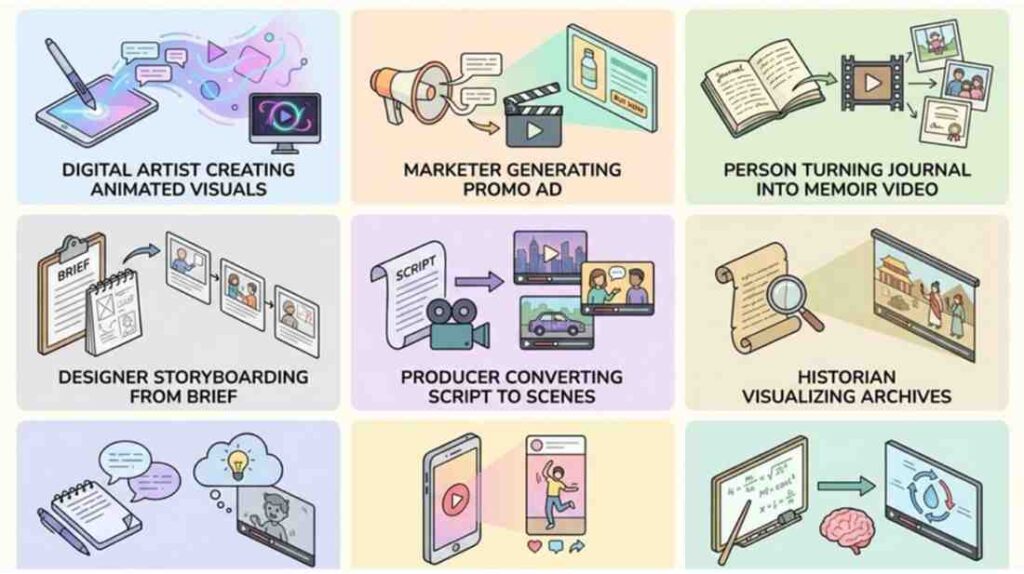
6. History: Reconstructing the Past with Text to Video Technology
Historical content has traditionally relied on static media such as text descriptions, images, or documentary footage that is often fragmented or inaccessible. Text to Video tools introduce a new way to interpret historical records by converting written archives into visual narratives.
Historians, educators, and content creators can use an AI Text to Video Tool to:
Visualize historical events described in documents or textbooks
Recreate timelines or daily life scenarios from written sources
Produce short educational videos from archival text
By enabling users to Create AI Videos from Text, these tools allow historical information to be contextualized visually without distorting factual accuracy. This approach does not replace academic rigor, but it enhances engagement and comprehension, especially for younger or non-specialist audiences.
7. Storytelling: From Written Narratives to Visual Worlds
Storytelling has always evolved alongside technology. Today, Text to Video tools provide writers with a way to test and expand narrative ideas without committing to full-scale production.
Writers and storytellers increasingly use AI Text to Video Tool platforms to:
Convert short stories into visual drafts
Explore pacing, atmosphere, and tone from text alone
Prototype episodic content based on written outlines
The ability to Create AI Videos from Text offers a low-risk environment for experimentation. Visualizing a story early helps creators identify structural issues and emotional gaps, strengthening the final narrative before traditional production begins.
8. Social Media: Scaling Short-Form Content
Social platforms demand constant content updates, yet manual video creation struggles to keep pace. This has made Text to Video technology particularly relevant for social media workflows.
Common applications include:
Turning captions or tweets into short-form videos
Repurposing blog paragraphs into vertical video formats
Maintaining consistent output across multiple platforms
By using an AI Text to Video Tool, social media managers can Create AI Videos from Text efficiently, ensuring messaging consistency while adapting to platform-specific formats. This supports a shift from handcrafted content to systematized creativity, without sacrificing relevance.
9. Education: Enhancing Learning Materials
Education increasingly depends on multimedia, but educators often lack the resources or skills to produce videos at scale. Text to Video tools address this gap by transforming existing learning materials into visual formats.
Educators and institutions apply AI Text to Video Tool solutions to:
Convert lesson notes into explainer videos
Create visual summaries from textbooks
Support remote and self-paced learning environments
The capacity to Create AI Videos from Text enables faster curriculum updates and improves accessibility. Visual reinforcement helps learners process complex concepts, particularly in subjects that benefit from sequential or spatial explanation.
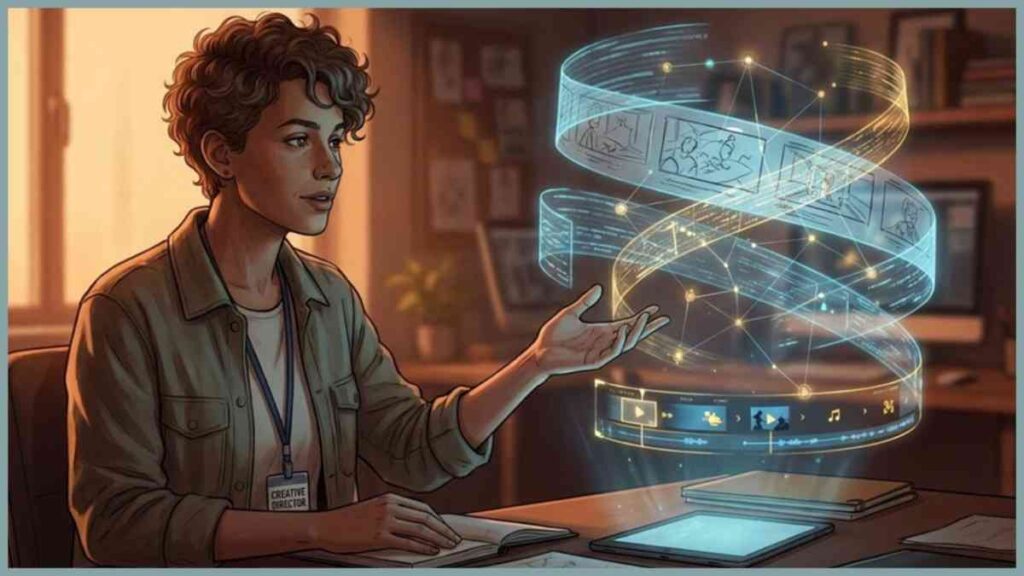
10. Human–AI Collaboration: Redefining Creative Workflows
Perhaps the most significant impact of Text to Video technology lies in how it reshapes human–AI collaboration. Rather than replacing creative professionals, AI Text to Video Tool systems act as amplifiers of intent.
In collaborative workflows:
Humans define narrative structure and meaning
AI handles visualization, composition, and repetition
Iteration becomes faster and more data-informed
When creators Create AI Videos from Text, they maintain conceptual control while delegating executional complexity. This model reflects a broader trend in AI adoption: tools that enhance productivity while preserving human judgment and creativity.
Final Thoughts: The Strategic Role of Text to Video in the AI Era
The rise of Text to Video tools is not a temporary trend, but a structural shift in how visual content is created and consumed. As written information continues to grow faster than visual production capacity, the ability to Create AI Videos from Text becomes increasingly strategic.
An AI Text to Video Tool represents more than automation—it reflects a convergence of language understanding, visual synthesis, and workflow optimization. Across art, marketing, education, and personal expression, these tools reduce friction between ideas and outcomes.
Looking ahead, the most impactful applications will not focus solely on novelty, but on integration: embedding text-to-video capabilities into existing creative and operational pipelines. As AI matures, the emphasis will move from “what AI can generate” to “how effectively humans can direct it.”
In that context, Text to Video technology stands as a foundational layer for future content ecosystems—quietly reshaping how stories, knowledge, and ideas are brought to life.
